How Much Does an Electric Patio Heater Cost to Run? 1500W–4500W Calculator
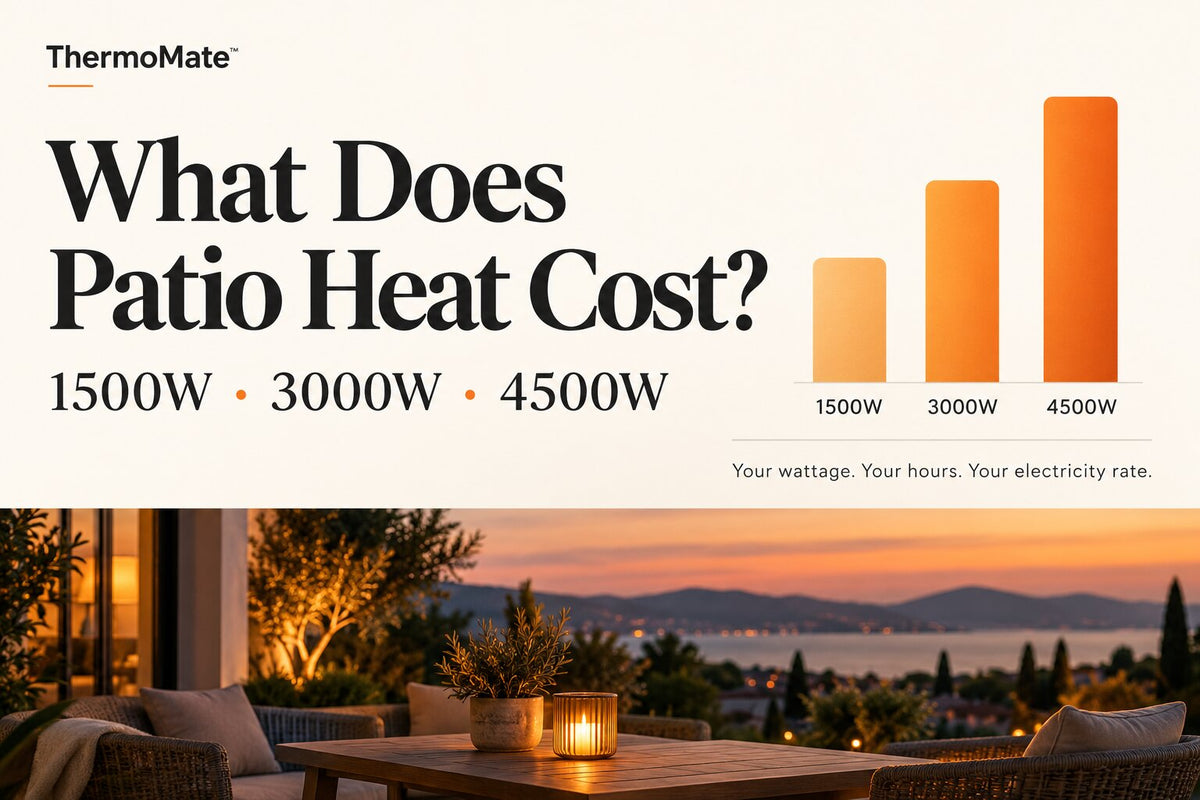
A 1500W electric patio heater costs $0.30 per hour at an electricity rate of $0.20 per kilowatt-hour when it runs continuously at rated power. Under the same assumptions, a 3000W heater costs $0.60 per hour and a 4500W heater costs $0.90. These are calculated examples, not a quoted utility rate or measured product results.
Your own running cost depends on the heater’s actual electrical input, how long it operates, how many units you use, and the electricity rate that applies during those hours. Here is how to turn those inputs into a useful budget before choosing a heater.
The quick formula for electric patio heater running cost
Cost = watts ÷ 1,000 × hours × electricity rate in dollars per kWh × number of heaters.
Watts describe power: the rate at which a heater uses electricity. Kilowatt-hours, or kWh, describe energy used over time. A heater drawing 1500W continuously for one hour uses 1.5 kWh. For three hours, it uses 4.5 kWh. Multiply that energy by your applicable electricity rate to estimate the energy charge.
For example: 1500 ÷ 1,000 × 3 hours × $0.20/kWh × 1 heater = $0.90 for the evening. Use the same approach for any documented power setting; substitute its wattage rather than assuming every setting uses the maximum.
1500W, 3000W and 4500W: hourly and monthly examples
The table below assumes one heater, continuous rated-power operation, three hours each day and 30 days per month. Electricity is priced at a hypothetical $0.20/kWh. All amounts are USD and cover energy charges only.
| Rated input | Energy per hour | Cost per hour | Cost per 3-hour evening | Cost per 30-day month |
|---|---|---|---|---|
| 1500W | 1.5 kWh | $0.30 | $0.90 | $27.00 |
| 3000W | 3.0 kWh | $0.60 | $1.80 | $54.00 |
| 4500W | 4.5 kWh | $0.90 | $2.70 | $81.00 |
A month of occasional use will look different. If you use the 1500W heater for three hours on just eight evenings, the same formula produces 36 kWh and $7.20 in energy charges. Count the days you actually expect to use your patio rather than automatically budgeting for every day.
Find the electricity rate that matches your bill
Start with your utility’s current tariff or bill. Look for usage-based electricity charges in dollars or cents per kWh, including applicable supply and delivery components. A rate of 20 cents per kWh must be entered as 0.20 dollars per kWh, not 20.
Dividing your entire bill by kWh can give an approximate blended cost, but it may include fixed charges you would pay even without the heater. For the additional cost of patio heating, the relevant starting point is the charge for additional electricity use. Tiered rates, taxes, credits and time-of-use schedules can require a more detailed calculation.
The U.S. Energy Information Administration’s electricity price table provides state and sector averages for context. Those averages are not your utility’s tariff. A homeowner and a restaurant in the same state may face different rate structures.
How sensitive is cost to the rate?
For one 1500W heater at rated power, an illustrative $0.15/kWh produces an hourly energy cost of $0.225, $0.20/kWh produces $0.30, and $0.35/kWh produces $0.525. These three rates are hypothetical comparison points, not current state averages. Keep full precision during the calculation and round the final total to cents.
If electricity costs $0.15/kWh for two hours and $0.30/kWh for another hour, calculate the periods separately: 1.5 × 2 × $0.15 + 1.5 × 1 × $0.30 = $0.90. Using only the lower rate for all three hours would understate the cost.
Use the calculator for your own patio
The downloadable Excel calculator lets you change the electricity rate, hours per day, days per month, number of heaters and average electrical-input fraction. It compares 1500W, 3000W and 4500W using the same assumptions. Leave the input fraction at 100% for a continuous rated-power estimate unless you have documented or measured information to support another value.
For a quick calculation, multiply your heater’s kW input by operating hours, electricity rate and number of heaters. The formula and example table above work without an embedded calculator.
Why heat settings and timers change the estimate
A control with nine heat levels does not establish that level three draws one-third of rated power. Depending on the design, controls may select elements, change input or cycle power. Use the exact model’s documented setting wattages, or a suitable measurement of average input, before assigning a percentage.
If a documented setting draws 750W continuously, it uses 0.75 kWh per hour and costs $0.15 per hour at $0.20/kWh. That is a mathematical example, not a statement that every 1500W model offers a 750W setting.
A timer can reduce expense by preventing unnecessary runtime. At the same 1500W input and $0.20 rate, shortening operation from three hours to two saves 1.5 kWh, or $0.30 per use. It does not change the heater’s cost for each hour it remains on. Automatic controls also do not replace the operating instructions or supervision requirements in the model’s manual.
Does 240V cost less to run than 120V?
At the same actual wattage and operating time, the energy calculation is the same regardless of voltage. A 3000W unit running for one hour uses approximately 3 kWh at rated input. Voltage affects electrical compatibility and installation requirements; it is not a discount factor in the kWh formula.
Do not choose a higher-power heater on operating cost alone. Confirm the exact model’s supply, connection and installation requirements before buying. Purchase price, mounting work and any required electrical work belong in a separate upfront budget. This article does not specify circuit sizes, wiring or installation clearances.
Budgeting for more than one heater
Two 1500W heaters drawing rated power together use the same nominal energy per hour as one 3000W heater: 3 kWh. At $0.20/kWh, either arrangement costs $0.60 per hour in energy. That does not mean they provide identical comfort or suit the same electrical installation.
If different seating areas are occupied at different times, calculate each unit separately. For example, one 1500W heater for three hours plus a second for one hour uses 6 kWh and costs $1.20 at the example rate. Assuming both run for three hours would instead produce $1.80.
For a restaurant, also check the commercial tariff. Demand charges can depend on peak power across the entire premises, so a simple kWh estimate may not capture the full change in the bill. A cost-per-seat calculation is meaningful only after confirming how many seats are actually comfortable in the layout; wattage alone does not establish usable seating coverage.
Electric versus propane: compare your actual use
For an electric heater, multiply electrical input in kW by runtime and the applicable electricity rate. For a propane heater, use documented fuel consumption for the chosen setting and your delivered or refill price. Include rental or delivery charges where relevant.
Do not compare a large propane heater at full output with a smaller electric unit and treat the cost difference as proof of equal warmth. Compare the occupied area, exposure, seating arrangement and operating time as well as fuel expense. Installation, storage and local use restrictions may also affect the decision. There is no universal percentage saving that applies to every patio.
Keep the budget useful without promising fixed savings
- Heat the seating area you actually use. Plan placement around people and the model’s permitted installation, then assess comfort in real conditions.
- Turn unused units off. The saving comes from avoiding energy use, not from an assumed efficiency percentage.
- Use a supported lower setting when comfortable. Confirm what that setting draws before estimating its cost.
- Track a typical week. Record operating hours, units used and settings. Update the estimate when your pattern changes.
- Check the tariff before the season. A rate change affects every wattage option in the same proportion when other inputs remain fixed.
Compare heater options after calculating the cost
Use the estimate to narrow your budget, then compare the product’s installation format, controls and electrical requirements. Explore ThermoMate’s 1500W carbon infrared patio heater, 3000W infrared heater and 4500W outdoor infrared heater. Check the current listing and exact model manual for specifications and suitability.
Choose the setup that fits your seating layout and installation, then use your actual rate and runtime to estimate its cost. A larger number on the power label tells you the electrical input to budget for; it does not, by itself, tell you how many people will feel comfortable.
Frequently asked questions
How much electricity does a 1500W patio heater use?
At continuous rated input, 1.5 kWh per hour. Three hours uses 4.5 kWh. Multiply by the applicable electricity rate to estimate the energy charge.
How much does it cost to run a 3000W heater for four hours?
At an illustrative $0.20/kWh, 3 kW × 4 hours × $0.20 = $2.40 for one heater. Your tariff and actual input may differ.
Is a 4500W patio heater three times as expensive as a 1500W heater?
For the same runtime, rate and number of units, each operating continuously at rated input, its energy cost is three times as high. That comparison does not establish equivalent comfort or overall installation cost.
Does infrared mean lower electricity consumption?
The cost calculation still depends on electrical input and runtime. Any reduction in your bill must come from using less chargeable energy or paying a lower applicable rate; do not apply a blanket infrared savings percentage.
Does this estimate include the whole electricity bill?
No. It estimates heater energy charges under the entered assumptions. Fixed fees, demand charges, tariff adjustments, taxes and other loads may require separate treatment.