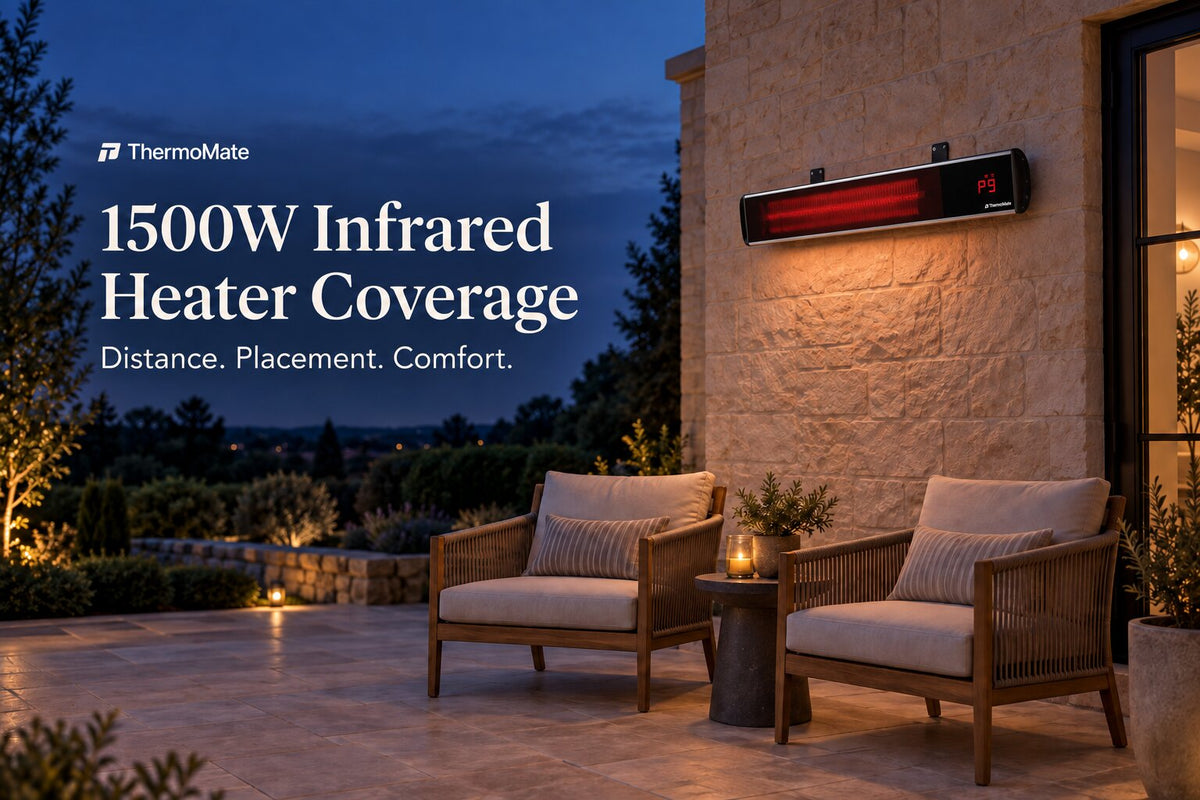
1500W infrared heater coverage depends on the heater, its position, and the conditions around your seats. Wattage alone cannot tell you how many feet away you will feel comfortable or how much of an open patio will feel warm. Start with the seats you want to use, then check whether a particular model can serve them from a permitted installation position.
This guide explains how to evaluate reach, compare mounting options, and assess your layout. It does not provide a field-tested coverage map or a guaranteed heating radius for any model.
How far does a 1500W infrared heater reach?
There is no single reliable distance for every 1500W infrared patio heater. The rated wattage describes electrical power. It does not specify the direction of the heat, the intensity at each seat, or the outdoor conditions under which someone will feel comfortable.
For planning, focus on an occupied seating area. A pair of chairs facing an appropriate heater position is a different problem from a long dining table, even if both fit inside the same patio. A heater that suits one arrangement may leave some seats in the other arrangement outside its useful radiant path.
Ask three separate questions before buying:
- Can it be installed here? Check the model's approved mounting method, required clearances, and electrical supply.
- Does its heat reach the occupied seats? Consider direction, distance, and anything blocking the path.
- Will those seats feel comfortable in your usual weather? A sheltered evening and an exposed, breezy evening are different conditions.
For the broader selection process, see the infrared patio heater buying guide.
Why square-foot coverage figures need context
A patio's floor area is easy to calculate. Its comfortable seating area is harder to predict. Multiplying length by width describes the paving, but says nothing about which way people face, how far they sit from the heater, or how exposed they are.
For example, a 10-by-10-foot layout and a 5-by-20-foot layout both measure 100 square feet. That arithmetic does not establish that one heater will serve both equally. The long layout may put the farthest chair much farther from a suitable mounting point. These are illustrative dimensions, not recommended coverage areas.
When comparing a coverage claim, look for the conditions behind it: mounting position, heat setting, ambient temperature, wind, and the definition of acceptable comfort. Without a shared test method, figures from different listings are not a dependable performance ranking.
What if product figures disagree? Ask for clarification before sizing your patio around them. At the time of this review, the EIHF1500V product page contains different coverage figures in its description and specifications. This guide does not select one as a verified result or use either to promise a heating radius.
What changes the comfort you feel at a seat?
Direction and an unobstructed path
Infrared heating transfers energy by radiation to surfaces in its path. The U.S. Department of Energy's electric infrared heating overview explains that this transfer depends on line of sight, distance, and angle. The same physical principles help explain why patio layout matters, although that industrial guide does not establish performance for a patio-heater model.
Use that principle as a layout check: identify the emitting face and the direction it faces. A solid partition or substantial furniture between the heater and a person can interrupt the direct path. A seat beside the heater should not automatically be counted as equivalent to a seat in front of it.
Distance and mounting position
As distance and angle change, the amount of radiant energy reaching a person changes. Heater geometry and reflector design also matter. A general distance formula cannot turn the 1500W label into a reliable comfort boundary for every product.
Measure from the proposed heater position to the occupied part of each seat, not simply from the wall to the edge of the patio. Include the difference in height. For an elevated wall heater, the path to a seated person is diagonal.
Keep installation limits separate from comfort estimates. A minimum mounting height is a safety requirement, not a statement of maximum reach. Do not lower a heater below its permitted height or move furniture inside required clearances to improve warmth.
Wind and exposure
Infrared heating can warm a person without first warming all the surrounding air. That does not make the person immune to wind. The National Weather Service explains that wind increases heat loss from exposed skin.
For patio planning, this means a breezy seat may feel less comfortable than a sheltered seat with a similar view of the heater. A roof alone does not describe wind exposure: note open sides and the direction of your usual evening breeze. Do not treat a weather-resistance rating as a promise of comfort in all weather.
Heat setting and how you use the space
Compare models at the operating setting you expect to use. A lower setting changes the heat available, and a timer changes how long the unit runs. Neither feature proves a larger coverage area.
Also define the experience you want. Reading in one chair, sharing a small table, and hosting people who move between several seating areas create different requirements. Write down the activity and the seats that matter before deciding how much of the patio must be served.
Plan around seats, then compare mounting options
The following table is a planning aid. It does not assign a tested coverage area or recommend a specific heater count.
| Your layout | What to check first | Useful next step |
|---|---|---|
| Two lounge chairs near a suitable wall | Whether both occupied seats face the radiant path from a permitted mounting position | Mark both chairs and compare their distance and angle to that position. |
| A long outdoor dining table | Whether end seats and opposite sides have substantially different exposure | Assess every seat instead of using the table center as the only reference. |
| A patio with changing furniture arrangements | Stable placement, cord routing, and the model's approved portable configuration | Compare freestanding or tripod options with the layout you use most often. |
| An open deck or several separate seating groups | Wind, distance, and whether one installation position can serve all occupied areas | Ask for a layout assessment before choosing additional heaters or higher power. |
Consider a simple example: two chairs usually face the garden, while the only suitable mounting wall is behind them. That is worth discussing before purchase. The patio may be small, but the arrangement still needs evaluation. Rotating seats might change their exposure, provided the revised layout keeps all required clearances and walking routes.
A freestanding model offers another placement format, but it still needs its approved base, guards, and clear space. A portable format does not make every position suitable.
Compare ThermoMate 1500W models by placement
These six models illustrate several mounting choices. The links below lead to the relevant product details; the comparison is about installation format, not tested reach. Check the current listing and exact model manual before ordering.
| Model | Listed mounting format | Planning question |
|---|---|---|
| EIH1500GLB | Wall-mounted | Can a permitted wall position serve the intended seats? |
| EIHF1500B | Freestanding | Is there a stable location with room for the required base, guard, and clearances? |
| EIHFW1500B | Freestanding or wall-mounted | Which approved configuration fits the layout and available power connection? |
| EIHSW1500B | Tripod or wall-mounted | Can the stand remain stable and clear of foot traffic? |
| EIHF1500V | Freestanding with oscillation | Does the moving heat direction suit your seating arrangement? Ask for coverage clarification. |
| EIH1500B | Wall-mounted | Does the mounting format fit, and is this model currently available? |
Oscillation changes where a heater points during its cycle. It does not increase its rated maximum wattage, and it should not be interpreted as equal, continuous warmth at every seat. Likewise, two products sharing a wattage do not necessarily distribute heat in the same way.
How to assess comfort in your own layout
Once a heater has been installed or assembled according to its instructions, a simple observation record can help you understand your actual seating arrangement. This is a household comfort check, not a standardized performance or safety test.
- Sketch the layout. Mark the heater, each occupied seat, open sides, and substantial obstructions. Give each seat a label.
- Record the setup. Note the exact model, mounting configuration, heat setting, and whether oscillation is active.
- Record conditions. Note the date, time, outdoor temperature if known, breeze, and whether sunlight affects the seats. Keep assumptions separate from measurements.
- Compare seats consistently. Sit in the normal position at each seat for a consistent observation period. Record your own description, such as comfortable, mildly warm, or little noticeable warmth.
- Repeat under relevant conditions. A second observation on a cooler or breezier evening may reveal limitations that were not apparent the first time.
- Change one permitted variable at a time. If evaluating another arrangement, keep other conditions as consistent as practical. Turn the heater off, disconnect it, and let it cool before moving or adjusting it as required by its manual.
Record differences rather than smoothing them into a single area claim. If the near chair feels comfortable but the far chair does not, that is useful information about this arrangement. It does not establish a universal maximum distance for the product.
An air-temperature reading alone cannot describe the entire radiant experience. If you record temperatures, identify what you measured and where. Do not label a furniture-surface reading as an air-temperature rise or a measure of human comfort.
Before adding another heater
First check whether the existing unit is operating at the intended setting and serving the seats from a permitted position. If the layout still has cold spots, share a sketch and photos with support. A different mounting format or a revised seating arrangement may be worth evaluating before purchasing more equipment.
Additional heaters require electrical planning as well as layout planning. Two nearby outlets do not necessarily provide independent circuit capacity. Have a qualified electrician confirm the supply for the proposed equipment and any installation work.
Follow the exact model's instructions for the receptacle, mounting, clearances, and weather exposure. The EIHF1500B manual, for example, requires a direct wall receptacle and prohibits extension cords and power strips. Do not use a longer cord as a workaround for an unsuitable heater position.
Consult the ThermoMate manual library and electric patio heater installation guide before finalizing the setup.
Frequently asked questions
How many square feet will a 1500W infrared heater warm?
There is no universal outdoor figure based on wattage alone. Review model-specific information and its test conditions, then evaluate the seats, mounting position, and weather. This guide does not verify a square-foot rating for any model.
Can one 1500W heater warm an entire patio?
That depends on the layout and what you mean by warm. Begin with the occupied seats and ask whether they can be served from one approved position. Avoid assuming that every part of a patio will feel equally comfortable.
Does infrared heat work on a windy patio?
Radiant energy can still reach people, but wind can increase their heat loss. Evaluate the exposed seats in realistic conditions instead of relying on a claim that comfort is unaffected by wind.
Does mounting a heater higher increase coverage?
Changing height changes distance and angle, so it does not automatically improve usable comfort. Stay within the manufacturer's permitted installation requirements and assess the occupied seats from that position.
Is remote-control range the same as heating range?
No. Remote range describes a control signal. It does not tell you how far away a person will feel warm. Keep those specifications separate when comparing listings.
Will two 1500W heaters double the covered area?
Not necessarily. Direction, overlap, obstructions, weather, and electrical capacity all matter. Plan each occupied area and have the proposed electrical load checked before adding units.
Choose a heater for the seats you use
Measure your layout, identify suitable mounting positions, and compare the models that fit those constraints. A useful decision starts with where people will sit and the conditions they expect to enjoy.
Explore ThermoMate infrared patio heaters, then use the product details and model manual to narrow your options.