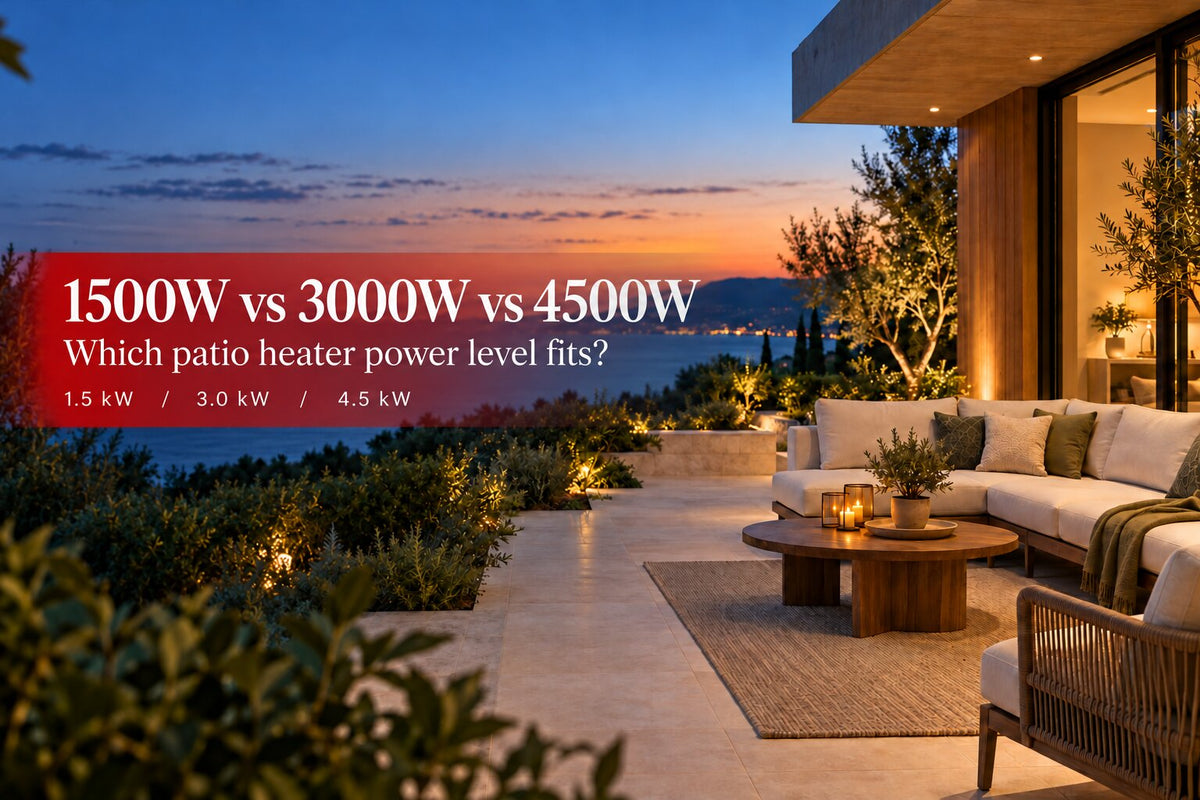
1500W vs 3000W vs 4500W Patio Heaters: Which Power Level Fits?
Choosing between 1500W, 3000W and 4500W patio heaters starts with two questions: where will people sit, and what electrical supply can serve that location? A higher wattage gives you more available heating power, but the number on the box cannot tell you how every seat will feel.
For a 1500W vs 3000W patio heater comparison, start with the installation. A suitable 120V supply makes a 1500W model a practical candidate for a focused seating area. A planned 240V installation opens up 3000W and 4500W options. From there, compare the actual model, mounting position, exposure and running cost before choosing.
Quick comparison: power, voltage and connection
The examples below are four ThermoMate models across three power categories. They illustrate important differences within the range; they are not a complete catalog or a guaranteed sizing chart. Product information was checked October 28, 2026.
| Model and rated maximum | Published electrical supply | Connection | Mounting format | Calculated current at the stated example voltage |
|---|---|---|---|---|
| EIH1500GLB — 1500W | 120V | Plug-in | Wall | 12.5A at 120V |
| EIHS3000B — 3000W | 240V | NEMA 6-15P plug | Wall | 12.5A at 240V |
| EIH3000B — 3000W | 220–240V in the product page title; confirm nameplate | Hardwired | Wall or ceiling | 12.5A at the 240V example point |
| EIH4500B — 4500W | 240V | Hardwired | Wall or ceiling | 18.75A at 240V |
Current values are arithmetic examples using amps = watts ÷ volts, not measured readings or circuit specifications. The EIH3000B example uses its nominal 3000W rating at 240V; do not assume it draws exactly 3000W at every voltage in its supply range. Use the actual nameplate and manual when planning an installation.
The important buying distinction: two 3000W heaters can require different connections. A plug-in 240V heater also requires a compatible 240V receptacle; it cannot use an ordinary 120V outlet simply because it has a plug.
What more watts change—and what they cannot predict
Rated watts describe electrical input power. At their rated maximum, a 3000W heater uses twice the input power of a 1500W unit, while a 4500W heater uses three times as much. Those ratios do not mean twice or three times the comfortable seating area.
Electric infrared patio heaters direct radiant energy toward people and surfaces. The energy reaching a particular seat depends on the heater's construction and its position relative to that seat. Some energy may reach unoccupied surfaces or directions that do little for the people you want to warm.
When comparing power levels, consider these factors together:
- Seating arrangement: A compact conversation group presents a different target from a long dining table or two separated lounges.
- Mounting geometry: Height, approved aiming angle and distance affect where the radiant output reaches. Keep every position within the exact manual's limits.
- Obstructions: Furniture, structural posts and other objects can interrupt the direct path between the heater and a person.
- Exposure: Wind, cold surfaces and ambient temperature affect comfort. Radiant heating does not make people immune to wind chill.
- Personal needs: Clothing, activity and individual preferences affect whether a setting feels comfortable.
A larger heater may offer useful additional power when the layout supports it. It cannot compensate for an unsuitable mounting location or reach every person around an obstruction.
Start with a seating zone, then compare power
Draw the part of the patio you actually occupy. Mark the chairs, table, doors, walkways, possible mounting surfaces and available electrical connection. A simple sketch often reveals a better starting point than the patio's total square footage.
For one sofa and two nearby chairs, ask whether a single approved position can face the group. For a dining table and a separate lounge, treat them as two potential zones. Add notes about exposed sides and where people sit most often.
Only then shortlist power levels. If the feasible mounting position leaves a seat outside the useful direction of the heater, adding wattage may do less than changing the layout. A revised position must still satisfy the model's mounting and clearance requirements.
Do not use a general indoor watts-per-square-foot rule to promise outdoor comfort. Outdoor seating areas do not retain heat like enclosed rooms, and advertised coverage figures need conditions to be meaningful.
How to read coverage claims
Treat a manufacturer's coverage figure as a starting claim to investigate. Ask what mounting position, outdoor temperature, wind conditions and comfort criterion produced it. Check whether the number describes an outdoor area or an enclosed space.
For example, ThermoMate's current 3000W product descriptions distinguish outdoor and enclosed coverage. The 4500W page also contains inconsistent area wording. These pages do not establish a controlled comparison showing that a particular wattage will warm your patio to a set temperature.
This guide does not assign a guaranteed square-foot area or heating distance to any power level. It also does not present a same-distance comfort test: no such measurements were collected for this article.
When a 1500W patio heater is a useful starting point
A 1500W option is worth investigating when your priority is a focused seating zone and you have a suitable 120V supply near the approved location. It can also make sense when installing a new 240V connection would outweigh the benefit you expect from the patio.
The wall-mounted EIH1500GLB is one example in this category. Other 1500W designs may offer different mounting formats, so choose by the complete model specification rather than assuming all 1500W heaters install alike.
The limit is the layout. A small patio can still have seats pointing in different directions, insufficient clearance or an exposed edge. “Small” does not automatically mean a 1500W heater will be comfortable, and 120V does not mean every existing outlet is suitable.
Check the circuit, outlet condition and placement before buying. If the cord cannot reach the appropriate outlet as instructed, resolve the supply location instead of extending the reach with a power strip or extension cord.
When to compare 3000W models
Consider 3000W when you want more available power than a 1500W unit and can support the specific heater's electrical and mounting requirements. This is a category to investigate for a planned installation, rather than a universal recommendation for a certain patio size.
ThermoMate's EIHS3000B is listed as a 240V model with a NEMA 6-15P plug. EIH3000B uses a hardwired connection. Decide which installation route is appropriate before comparing their other features.
The EIHS3000B page currently describes a carbon fiber element, although its URL still contains the older words “golden-halogen.” Follow the current model documentation and confirm the exact supplied version rather than choosing by the URL wording.
If you are renovating, include the heater location in the electrical plan early. Share the model's nameplate, manual, mounting position and expected operating pattern with a licensed electrician. That gives a useful basis for assessing the installation and obtaining a quote.
When a 4500W model belongs on the shortlist
A 4500W model is worth assessing when a layout calls for greater available power and you are prepared for a fixed installation. It should earn its place through a workable plan, rather than being the default answer to a large patio.
The EIH4500B product page specifies a 240V hardwired connection. Its manual states outdoor use only and specifies a well-protected mounting environment. EIH3000B's manual also calls for a well-protected location. Exposure restrictions matter as much as maximum power. A long or divided seating arrangement may still need a different approach from one centrally occupied area.
Also consider how you will use the controls. Maximum wattage is only one operating point. Confirm the heat settings for the exact product version; do not assume every numbered setting represents an equal wattage step. The current EIH4500B page has differing descriptions of its available settings, so confirm those details before relying on a specific lower-power mode.
One higher-power heater or multiple smaller units?
Two 1500W heaters have 3000W of combined rated input, but they do not automatically produce the same comfort pattern as one 3000W heater. Separate units can face separate areas; one unit may suit a single continuous zone. The best arrangement depends on mounting options and where people sit.
Multiple units also mean more connections, controls and installation checks. Two outlets may share one circuit. Do not assume that different sockets can support two high-load heaters together.
Use total wattage to compare energy use, then assess each physical layout separately. A two-zone plan is a design option to review, not permission to distribute heaters around whatever outlets happen to be available.
Compare running cost at the same operating conditions
The U.S. Energy Information Administration explains that watts measure power and kilowatt-hours measure energy over time. For a constant input, use:
Energy cost = watts ÷ 1000 × operating hours × electricity rate per kWh.
Here is a hypothetical comparison at $0.20/kWh, for one heater running continuously at its rated maximum. This is an energy-charge example, not a local tariff or a measured product bill.
| Rated input | Energy in one hour | Cost for one hour | Cost for three hours |
|---|---|---|---|
| 1500W | 1.5 kWh | $0.30 | $0.90 |
| 3000W | 3.0 kWh | $0.60 | $1.80 |
| 4500W | 4.5 kWh | $0.90 | $2.70 |
Replace the example rate with your own applicable rate. Taxes, fixed charges, commercial demand charges and installation costs are excluded. Different settings or on/off periods change consumption; use documented input values or suitable measurements rather than guessing from a control label.
At the same actual wattage and operating time, 240V does not automatically halve the energy charge compared with 120V. Voltage affects the electrical arrangement; cost follows the energy consumed and your tariff.
Three buying situations to work through
An existing patio with only a suitable 120V connection: Start by assessing a 1500W model, its allowed position and the seats it can face. If the arrangement cannot work within the instructions, reconsider the position or electrical plan before buying a larger unit.
A patio renovation with one main seating area: Compare a 3000W and a 4500W installation using the same proposed seating plan. Ask about the mounting geometry, connection, exposure restrictions and total installed cost. A workable lower-power option may fit your use better than extra capacity you rarely select.
A dining area plus a separate lounge: Assess each zone independently. Compare a multi-unit approach with a single higher-power location, including total electrical load and whether you will usually occupy both zones at once. Do not promise a heater count from floor area alone.
These are planning examples, not tested model recommendations. They help identify the questions that need answers for your own space.
Before you order: a short installation checklist
- Match the exact SKU and supplied version to its nameplate and official manual.
- Check permitted use, weather exposure, mounting orientation, height and clearances. A patio roof or an IP rating does not override those instructions.
- Confirm voltage and connection type. Have a licensed electrician assess new circuits, receptacles, hardwiring and applicable local requirements.
- Include other loads and all planned heaters. Calculated operating amps do not specify breaker size, conductor size or a complete compliant circuit.
- Keep connections and cord routing consistent with the manual. CPSC guidance for portable electric heaters advises direct wall-outlet connection and avoiding extension cords and power strips.
Do not reduce a required clearance to bring heat closer. If the proposed location does not meet the instructions, change the plan.
Frequently asked questions
Is a 3000W patio heater twice as warm as a 1500W heater?
It has twice the rated input power. Perceived warmth and comfortable coverage do not follow that ratio automatically; position, heater design, exposure and the occupied seats matter.
Can I run a 3000W heater from a standard 120V outlet?
The two 3000W models compared here require a 240V-class supply. Do not use an adapter to connect them to an ordinary 120V outlet. Follow the exact product documentation.
Does 4500W mean I only need one heater?
No. A single unit may not address separated or obstructed seating zones. Review the layout and installation options rather than choosing unit count from maximum wattage.
Are two 1500W heaters cheaper to run than one 3000W heater?
At full rated input for the same time, both arrangements total 3000W and use the same calculated energy. Operating fewer units or different settings changes the comparison, as does the actual power consumed.
Can I use one universal mounting height for all three power levels?
Use the instructions for the exact model and mounting method. Wattage alone does not establish an approved mounting height, aiming angle or clearance.
Which power level should I buy first?
Shortlist the models your electrical supply and mounting location can support. Then compare how they address your occupied seating zone, exposure, controls and budget. Explore ThermoMate electric infrared patio heaters with that plan in hand, and confirm the model instructions before ordering.