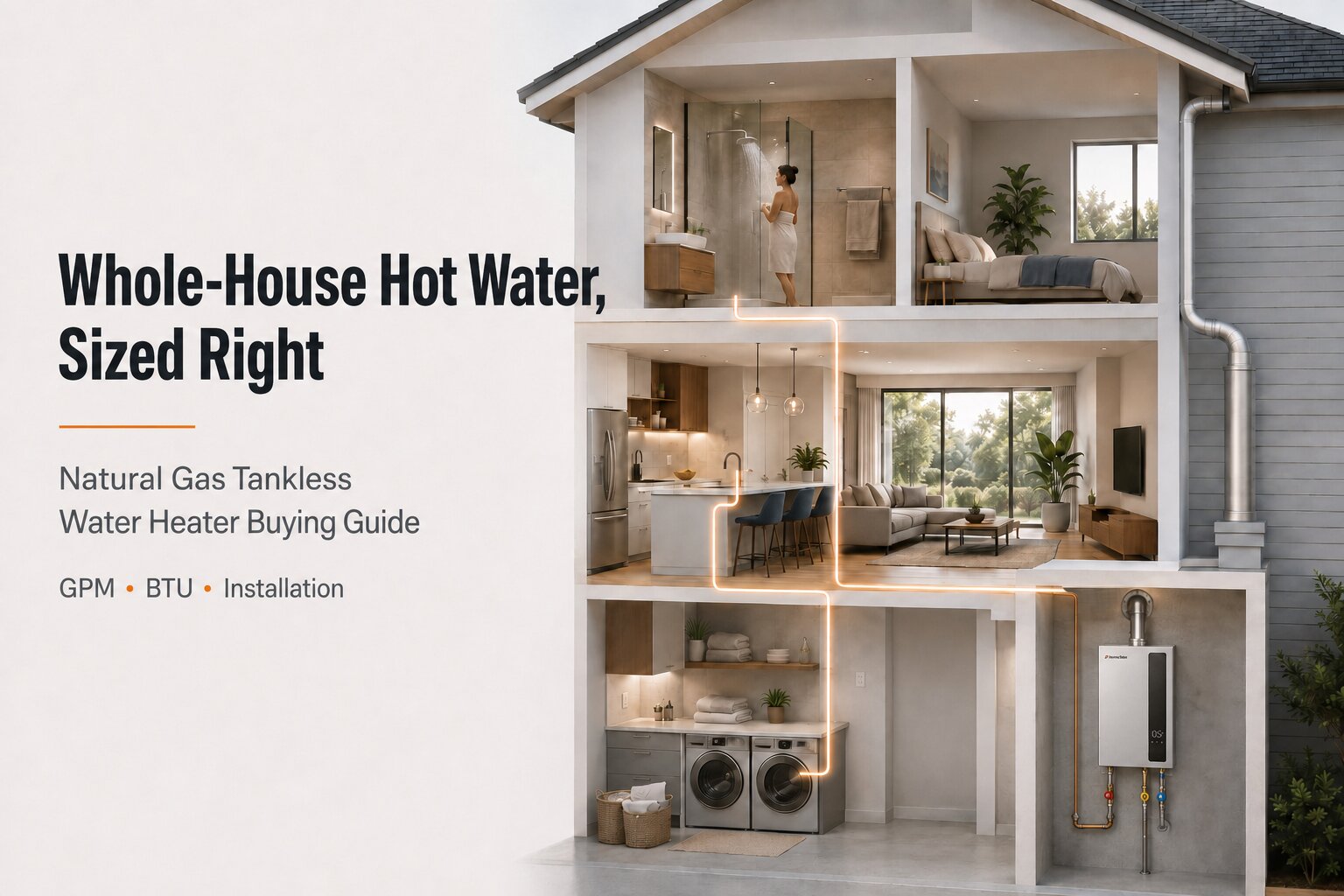
Natural Gas Tankless Water Heater for Whole House: Buying Guide
Choosing a natural gas tankless water heater for whole house use is not simply a matter of buying the model with the highest advertised flow rate. The right system must be able to meet your household’s peak hot water demand while accounting for incoming water temperature, fixture flow rates, gas supply, venting, water quality, and installation conditions.
When correctly sized, a whole-house natural gas tankless water heater can supply continuous hot water within its rated capacity, eliminate the need for a bulky storage tank, and reduce the standby energy losses associated with keeping dozens of gallons of water hot around the clock.
This guide explains how to calculate the capacity you need, compare condensing and non-condensing models, understand installation requirements, and choose the right ThermoMate unit for your home.
Quick answer: For many one- to two-bathroom homes, a unit in the 4.0–6.0 GPM range may be suitable, depending on the local groundwater temperature and how many fixtures run simultaneously. Larger homes, colder regions, and households that frequently use multiple showers may require a higher-output model above 6.0 GPM.

What Is a Whole-House Natural Gas Tankless Water Heater?
A whole-house tankless water heater heats water as it flows through the unit instead of storing preheated water inside a tank. When someone opens a hot water fixture, a flow sensor activates the burner. Water passes through the heat exchanger, reaches the selected temperature, and travels through the home’s plumbing system.
Unlike a point-of-use heater that serves one sink or one bathroom, a whole-house unit connects to the home’s main hot water line and may supply:
- Bathroom showers and faucets
- Kitchen sinks
- Dishwashers
- Washing machines
- Multiple fixtures operating at the same time
The term “continuous hot water” means the system can keep heating water as long as the demand remains within its rated flow and heating capacity. A tankless heater can still become overloaded if the combined demand from several fixtures exceeds what it can heat at the required temperature rise.
Homeowners can compare available capacities in the ThermoMate natural gas tankless water heater collection.
Is a Natural Gas Tankless Water Heater Good for a Whole House?
A natural gas model can be an excellent whole-house solution for homes that already have natural gas service and need more heating capacity than many electric tankless systems can provide.
Continuous Hot Water Within the Rated Capacity
A properly sized system does not have to stop and refill like a traditional tank. This can be particularly useful for families taking back-to-back showers or using hot water in the kitchen and laundry room during the same period.
Strong Heating Performance
Natural gas burners can deliver substantial BTU output, making gas tankless units suitable for higher flow rates and larger temperature rises. This is especially important in colder regions where the incoming water may be much colder during winter.
Less Floor Space
Most residential tankless systems mount on a wall, freeing up floor space in a utility room, basement, garage, or mechanical closet.
Reduced Standby Energy Waste
Because the heater operates when hot water is requested, it does not continuously reheat a stored volume of water. Actual savings depend on household usage, fuel rates, equipment efficiency, and the condition of the existing system.
Not the Best Fit for Every Home
A natural gas tankless system may be less practical when the home does not have a suitable natural gas connection, the existing gas line cannot support the required BTU load, venting is difficult, or the installation would require extensive plumbing and gas upgrades.
For a broader look at equipment, installation, operating, and long-term ownership expenses, read Are Tankless Water Heaters Worth It? Real Cost Breakdown.
How to Size a Natural Gas Tankless Water Heater for Whole-House Use
The two most important sizing factors are peak simultaneous flow rate and temperature rise. Household size and bathroom count are useful starting points, but they do not provide enough information on their own.

Step 1: Calculate Peak Simultaneous Flow Rate
Peak flow is the total number of gallons per minute needed when the household is using the most hot water. Do not add every fixture in the home. Add only the fixtures that could realistically operate at the same time.
For example, a household may expect to use:
- Two 2.0 GPM showers: 4.0 GPM
- One bathroom or kitchen faucet: approximately 1.0 GPM
The estimated peak demand would be approximately:
4.0 GPM + 1.0 GPM = 5.0 GPM
In this example, the homeowner should evaluate a model that can provide at least 5.0 GPM at the home’s required temperature rise. For better accuracy, check the rated flow printed on each showerhead, faucet, dishwasher, and washing machine.
See our guide to understanding shower water consumption for more information about shower flow rates and household water use.

Step 2: Determine the Required Temperature Rise
Temperature rise is the difference between the incoming cold water temperature and the desired outlet temperature.
Required temperature rise = Desired outlet temperature − Incoming water temperature
Suppose the incoming water temperature is 50°F and the desired hot water temperature is 120°F:
120°F − 50°F = 70°F temperature rise
The colder the incoming water, the more energy the heater must use to reach the selected outlet temperature. As the required temperature rise increases, the maximum available GPM usually decreases.
This is why a model advertised at a certain maximum GPM may deliver less water during winter or in a cold-climate installation. Always review the product’s temperature-rise performance information rather than relying only on the headline GPM.
Step 3: Check the BTU Output
BTU input or heating capacity indicates how much heat the burner can produce. A higher BTU rating generally helps the unit support a higher flow rate, a greater temperature rise, or both.
However, BTU should not be considered independently. A well-matched system combines sufficient BTU output, an appropriate flow rate, effective temperature control, and a gas supply that can support the equipment at full operation.
Step 4: Add a Practical Capacity Margin
A system should not be sized so closely that normal seasonal changes or a small increase in household demand pushes it beyond its limit. Consider a higher-capacity model when:
- Two or more showers frequently run together
- The home is in a colder region
- The household uses large showerheads or body sprays
- Hot water appliances commonly run during shower time
- The family may grow or add another bathroom
- The home has unusually high peak hot water demand
What Size Tankless Water Heater Do I Need?
| Household Demand | Planning Range | Possible Application |
|---|---|---|
| Light demand | Approximately 2.5–3.5 GPM | Small home, apartment, guest house, or one primary fixture |
| Moderate demand | Approximately 3.5–4.5 GPM | Small to medium home with one or two simultaneous fixtures |
| Two-bathroom demand | Approximately 4.5–6.0 GPM | Two bathrooms or several fixtures with managed simultaneous use |
| High whole-house demand | 6.0 GPM or higher | Larger household, colder climate, multiple showers, or frequent appliance use |
These ranges are planning estimates, not universal rules. Final sizing must be based on the actual fixture flow rates and the model’s output at the required temperature rise.
Households with multiple bathrooms can also review our guide to choosing the best gas tankless water heater for large families.
ThermoMate Natural Gas Tankless Water Heater Comparison
ThermoMate offers multiple natural gas capacities for different household demands. The following comparison can help narrow the options before reviewing the detailed performance data and installation manual.
| ThermoMate Model | Maximum Flow | Heating Capacity | Recommended Starting Point |
|---|---|---|---|
| CZ360NG Natural Gas Tankless Water Heater | Up to 4.05 GPM | 98,500 BTU | Small to medium households with approximately two to three compatible fixtures under suitable operating conditions |
| CZ422NG Natural Gas Tankless Water Heater | Up to 4.4 GPM | 113,000 BTU | Moderate residential demand, including two to three compatible fixtures under suitable conditions |
| CZ480NG Condensing Natural Gas Tankless Water Heater | Up to 5.28 GPM | 114,000 BTU | Busy households, two-bathroom applications, or approximately three to four compatible fixtures under suitable conditions |
| RTC68iN Condensing Natural Gas Tankless Water Heater | Up to 9.38 GPM depending on inlet temperature | 163,000 BTU | Higher-demand whole-house applications, larger households, and homes using several fixtures simultaneously |
Important: Maximum GPM ratings are influenced by incoming water temperature and the selected outlet temperature. Compare each model’s performance with your calculated temperature rise before making a final decision.

Condensing vs. Non-Condensing Natural Gas Tankless Water Heaters
Whole-house gas tankless systems generally fall into two categories: condensing and non-condensing.
Non-Condensing Models
A non-condensing water heater uses a primary heat exchanger to transfer heat from combustion gases to the water. Exhaust temperatures are typically higher, so the unit must use the venting materials specified in its installation manual.
Potential advantages include:
- Lower initial equipment cost
- Simpler internal design
- Good performance for moderate residential demand
Condensing Models
A condensing water heater uses an additional heat exchanger to recover more heat from the exhaust before it leaves the unit. This can improve efficiency and lower the exhaust temperature.
Potential advantages include:
- Higher energy efficiency
- More heat recovered from combustion gases
- Potential compatibility with approved PVC venting on specific models
- Strong suitability for frequent whole-house use
Condensing systems also create condensate that must be routed to an approved drain. Depending on the installation and local requirements, a condensate neutralizer may be recommended to help protect the drainage system.
Never assume that PVC or another vent material is suitable for every gas tankless water heater. Use only the venting system listed in the specific product manual.

Installation Requirements to Check Before Buying
Professional installation is strongly recommended for a natural gas tankless water heater. Before selecting a model, ask a qualified installer to evaluate the following areas.
1. Natural Gas Supply Capacity
The gas meter, regulator, piping diameter, piping length, and total household appliance load must support the water heater’s BTU requirement. A line that was adequate for a lower-output tank heater may not automatically support a high-output tankless system.
The installer should calculate the combined demand from the water heater, furnace, range, dryer, fireplace, and any other gas appliances.
2. Venting Route and Materials
Indoor gas water heaters must safely direct combustion exhaust outdoors. Vent diameter, material, maximum equivalent length, elbows, termination clearances, combustion air, and drainage requirements vary by model.
Installation should always follow:
- The ThermoMate installation manual
- Local building and fuel-gas codes
- Vent manufacturer requirements
- Requirements of the local authority having jurisdiction
3. Condensate Drainage
A condensing model needs a suitable route for condensate discharge. The installer should determine whether a gravity drain, condensate pump, neutralizer, or additional freeze protection is necessary.
4. Electrical Power
Although natural gas provides the heating energy, most modern gas tankless units require electrical power for ignition, sensors, controls, displays, exhaust fans, and built-in protection functions.
A nearby outlet and appropriate circuit should be available according to the manual and local code.
5. Water Pressure and Plumbing Condition
Confirm that the home has sufficient water pressure and flow. Old, restricted, or heavily scaled pipes can reduce actual performance even when the water heater itself has adequate capacity.
6. Service Access
Leave enough clearance for inspection, flushing, filter cleaning, repairs, and eventual replacement. Isolation valves and service ports can make routine maintenance significantly easier.
Before installation, visit the ThermoMate manual download center and review the instructions for the exact model being considered.
Will a Tankless Water Heater Provide Instant Hot Water at Every Faucet?
“Tankless” and “instant” describe how the heater produces hot water, not how quickly the water travels through the pipes.
If the heater is far from a bathroom or kitchen, the cooled water already sitting in the pipe must leave before newly heated water reaches the fixture. A tankless system can therefore provide continuous hot water without eliminating the initial wait caused by a long plumbing run.
Homes with long pipe distances may benefit from:
- Better heater placement
- Insulated hot water piping
- A compatible recirculation solution
- A small point-of-use heater in a distant location
Confirm recirculation compatibility before adding a pump or return loop to any tankless system.
How Much Does a Whole-House Natural Gas Tankless Water Heater Cost?
The complete project cost includes more than the water heater itself. Installation expenses may include:
- Gas piping upgrades
- Vent pipe and termination components
- Condensate drainage
- Water line modifications
- Isolation and service valves
- Electrical work
- Permits and inspections
- Removal of the existing water heater
A straightforward replacement may cost less than a project requiring a larger gas line, a new vent route, structural access, or extensive plumbing changes.
Ask for a written installation estimate before purchasing the equipment. The estimate should identify the selected model, gas line work, venting materials, condensate provisions, permits, and labor.
Maintenance and Water Quality
Tankless water heaters require routine inspection and maintenance. Mineral buildup inside the heat exchanger can restrict flow, reduce heat transfer, cause temperature instability, and place additional stress on internal components.
Maintenance needs depend on:
- Water hardness
- Daily hot water use
- Operating temperature
- Installation environment
- Manufacturer recommendations
A typical maintenance visit may include inspecting the venting and gas system, cleaning inlet filters, checking the burner and heat exchanger, flushing mineral deposits, inspecting condensate components, and confirming that safety controls operate correctly.
Watch for reduced flow, unusual sounds, temperature fluctuations, longer heating times, or error codes. Learn more in 5 Signs It’s Time to Descale Your Tankless Water Heater.
Common Buying Mistakes to Avoid
Choosing by Bathroom Count Alone
Two homes with two bathrooms can have very different demands. Showerhead flow, family routines, groundwater temperature, and appliance use all affect the required capacity.
Using Maximum GPM Without Checking Temperature Rise
Headline flow rates are generally achieved under specified operating conditions. Colder inlet water reduces the amount of hot water the unit can produce at the selected temperature.
Ignoring Gas Line Capacity
A high-output water heater cannot operate correctly if the gas supply cannot deliver the required fuel volume.
Assuming Every Venting Material Is Compatible
Condensing and non-condensing units may require different vent systems. Follow the exact model manual rather than copying the venting arrangement of another heater.
Buying the Wrong Fuel Type
Natural gas and propane models are not interchangeable. Purchase the unit that matches the home’s actual fuel supply.
Skipping Professional Installation
Incorrect gas piping, combustion air, exhaust venting, condensate drainage, or electrical connections can create safety and performance problems.
Natural Gas Tankless Water Heater for Whole House FAQ
What GPM tankless water heater do I need for a two-bathroom house?
Many two-bathroom homes begin their search in the 4.5–6.0 GPM range. However, the correct capacity depends on whether both showers run simultaneously, the flow rate of each fixture, and the required temperature rise. Colder climates or high-flow showers may require a larger unit.
Can one natural gas tankless water heater supply an entire house?
Yes. One properly sized natural gas tankless water heater can serve a whole house. The unit must provide enough flow and heating capacity for the home’s realistic peak demand.
Can I run two showers at the same time?
Yes, provided the combined shower flow does not exceed the heater’s output at the required temperature rise. Two 2.0 GPM showers require approximately 4.0 GPM before adding demand from sinks or appliances.
Does a natural gas tankless water heater require electricity?
Most modern models require electrical power for ignition, control boards, sensors, displays, fans, and safety systems, even though natural gas supplies the heat.
Does a natural gas tankless water heater need venting?
Yes. Indoor gas-fired tankless water heaters require an approved system to direct combustion exhaust outdoors. Vent materials and configurations vary by model, so follow the installation manual and local codes.
Is a condensing tankless water heater better?
A condensing model may provide higher efficiency by recovering additional heat from the exhaust. It may also support different approved venting options. However, it requires condensate drainage and may have a higher initial equipment cost.
How often should a tankless water heater be flushed?
The appropriate maintenance interval depends on water hardness, usage, and the manufacturer’s instructions. Homes with hard water or heavy daily demand may need more frequent service than homes with treated or naturally soft water.
Can I replace a traditional gas tank water heater with a tankless model?
In many homes, yes. However, the conversion may require gas line, venting, water piping, electrical, drainage, or permit-related upgrades. Have the installation location evaluated before purchasing the unit.
Final Buying Checklist
Before ordering a natural gas tankless water heater for whole-house use, confirm the following:
- Your home has natural gas service
- You have calculated realistic simultaneous GPM demand
- You know the winter incoming water temperature
- The selected model can meet the required temperature rise
- The gas line and meter can support the total BTU load
- There is a compliant venting route
- Condensate drainage is available for a condensing model
- Electrical power is available near the installation location
- The unit will remain accessible for maintenance
- A qualified installer has reviewed the project
Choose the Right ThermoMate Whole-House System
The best natural gas tankless water heater for whole house use is the one that matches your actual peak demand—not simply the largest or least expensive model.
Start by adding the flow rates of the fixtures your household uses simultaneously. Then calculate the temperature rise from winter groundwater temperature to the desired outlet temperature. Finally, confirm gas supply, venting, drainage, electrical power, and installation requirements with a qualified professional.
Explore the complete ThermoMate natural gas tankless water heater collection to compare whole-house models, flow rates, BTU capacities, condensing options, and product specifications.