Can You Use an Electric Patio Heater Indoors? Check the Model First
Short answer: sometimes—but only when the exact heater’s current manual and rating label permit the intended indoor location. “Electric” does not automatically mean “approved for every indoor space,” and a product name or marketing image is not a substitute for the installation manual.
Important: if the product page, specifications and manual disagree, stop. Follow the current manual and rating label, then contact ThermoMate support before installing or operating the heater. Do not choose the least restrictive wording.
This guide explains how to make that model-first decision for a garage, workshop, enclosed porch or other indoor area. It also corrects an easy mistake: assuming that every electric patio heater is suitable indoors because it does not burn propane or natural gas.
Electric patio heaters are not all approved for the same locations
An electric infrared heater does not create combustion gases at the appliance, so it avoids the carbon-monoxide risk associated with bringing an outdoor fuel-burning patio heater into an enclosed space. That difference matters, but it is only the first check.
Indoor suitability also depends on the heater’s listing, construction, mounting method, electrical connection, required clearances, moisture restrictions and the language in its manual. A model designed only for an open patio can still present fire, burn or electrical hazards when moved into a tighter room with curtains, paper, furniture, stored fuel or limited clearance.
That is why the correct question is not simply, “Is it electric?” It is:
Does the current manual for my exact model explicitly allow this exact type of indoor location, and can the installation meet every listed condition?
Start with the model number—not the product category
Find the model number on the heater’s rating label, order confirmation or original carton. Do not rely on appearance alone; several heaters may share a similar black bar or tower design while using different voltages, mounting systems and instructions.
- Match the exact model number. A similar product title is not enough.
- Open the current manual. Use the ThermoMate manual library or the manual supplied with the unit.
- Read the intended-use statement and every warning. Search for “indoor,” “outdoor,” “garage,” “bathroom,” “combustible,” “extension cord,” “mounting height” and “power supply.”
- Compare the manual with the rating label. Voltage, frequency and wiring method must agree.
- Stop if information conflicts or is missing. Ask ThermoMate support to confirm the current instruction for that model.
What ThermoMate’s current manuals say about two commonly confused models
The examples below show why the model-first approach matters. They were checked against the manuals linked from ThermoMate’s U.S. manual page on August 11, 2026. Manuals and product pages can change, so verify again before use.
| Model | What the current evidence says | Indoor-use decision |
|---|---|---|
|
EIHF1500V 1500W freestanding tower |
The product title and description use “Outdoor/Indoor,” but the same product page lists usage and room type as “Outdoor.” More importantly, the official manual’s opening instruction page states “Outdoor Use Only.” | Do not use indoors based on the current manual. The conflicting product-page wording should be clarified before purchase or use. |
|
EIH3000B 3000W wall/ceiling heater |
The official manual says the heater is intended for bathrooms, laundry rooms and similar indoor locations. It also gives indoor/well-protected coverage guidance. The product page requires 220–240V hardwiring to a dedicated circuit. | Potentially suitable only when every manual condition is met. Indoor permission does not waive mounting, clearance, wiring, moisture or local-code requirements. |
| Other ThermoMate patio-heater models | Do not infer indoor approval from infrared technology, IP rating, a garage photo or similarity to another heater. Newer models may not appear in the same manual library. | Treat indoor approval as unverified until the exact current manual says otherwise. |
This comparison also illustrates an editorial rule worth following on every safety topic: when a product page and manual conflict, the article should surface the conflict instead of smoothing it over.
Do not confuse indoor approval, weather protection and heating coverage
These three pieces of product information answer different questions. Treating one as proof of another is a common reason patio heaters end up in the wrong location.
Intended-use wording answers where the model may be used
Look for direct language such as “outdoor use only” or a statement that names permitted indoor locations. This is the evidence that matters for the first decision. A photo of a garage, a category named “space heaters,” or the word “infrared” does not provide the same approval.
An IP rating describes resistance to solids and water
IP54, IP55 and IP65 ratings can help distinguish levels of enclosure protection, but they do not tell you whether a heater is suitable for a bedroom, garage or bathroom. An IP-rated outdoor heater can still be outdoor-only. Conversely, a manual that permits a particular indoor installation can still impose strict rules around baths, pools and other liquid sources.
Coverage describes expected heating performance
A statement such as “130 sq. ft. enclosed” helps set comfort expectations under certain conditions. It does not certify the room, approve the wiring or replace a clearance diagram. Coverage can also vary with mounting height, aiming, insulation, air movement and ambient temperature.
Use the information in order: first confirm intended use, then confirm installation and electrical requirements, and only then consider whether the rated output is likely to make the seating or work zone comfortable.
Can you use an electric patio heater in a garage?
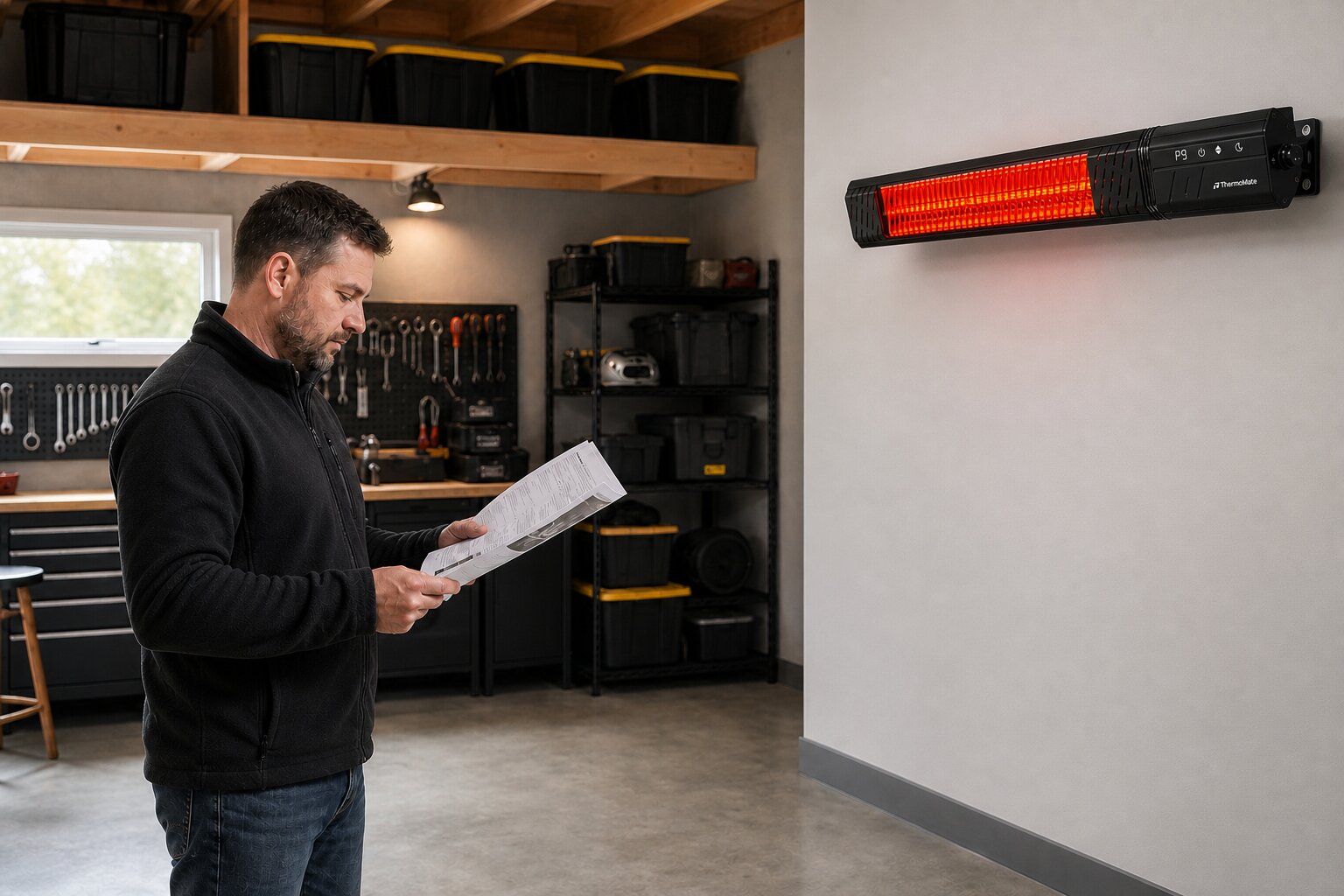
A garage is not automatically an outdoor space, and “garage” in a product description is not the same as unconditional approval. Garages often combine tight clearances, storage, dust, vehicles, fuel, paint, aerosols and electrical loads. Those conditions can be more demanding than a clear patio wall.
Use a heater in a garage only if the exact model manual permits the location and the complete installation is suitable. Before proceeding, confirm all of the following:
- The manual allows indoor, garage or similar use; it does not say “outdoor use only.”
- The heater can be mounted at the required height and angle without pointing at vehicles, shelving, paper, fabric or stored materials.
- Gasoline, propane cylinders, paint, solvents and other flammable vapors or materials are not present in the heater’s operating area.
- The electrical supply matches the heater. A 240V hardwired heater is not a plug-in 120V appliance.
- The heater will not be operated through an extension cord, power strip or relocatable tap when the manual prohibits them.
- Children, pets and moving workpieces cannot contact the hot surface or enter the heat path.
- Local electrical and building requirements permit the installation.
If you cannot answer every item with the manual, rating label and installation plan in front of you, pause and use a heater specifically listed for the room instead.
Clearance is a model instruction, not a universal number
Generic online advice often repeats a single clearance number for every patio heater. That is not reliable enough for installation. Clearance can differ by model, mounting direction and the surface being measured.
For example, the EIH3000B manual warns users to keep combustible materials such as furniture, pillows, curtains and paper at least 3 feet (0.9 m) from the front, while keeping them away from the sides and rear. The same manual shows a minimum installation height of 94.5 inches and a 30°–45° aiming angle. Those instructions belong to that model and should not be copied to another heater without checking its manual.
Measure from the points shown in the manufacturer’s diagram—not from the wall, bracket or nearest convenient edge unless the manual says to do so. Recheck after aiming the heater because changing the angle changes what sits in the radiant path.
For a complete installation workflow, use the electric patio heater installation guide together with the exact manual. If the two disagree, the current model manual controls.
Check the electrical connection before you check room size
Room size matters for comfort, but the electrical connection is a go/no-go safety check.
120V plug-in models
Confirm that the receptacle, circuit and heater rating match. Plug the heater directly into an appropriate wall receptacle when required by the manual. Do not assume a household power strip is suitable for a high-load heater. If a plug or receptacle becomes hot, disconnect the heater and have the electrical system inspected.
220–240V hardwired models
The EIH3000B product page and manual identify it as a hardwired 220–240V heater. That means it needs a permanent, correctly sized supply and installation consistent with the manual and local requirements. It is not a standard-outlet appliance. Use a qualified electrician for a hardwired installation and for any uncertainty about circuit capacity, grounding or disconnecting means.
Never improvise an adapter, substitute a cord, or change the wiring method to make a heater fit an available outlet.
Indoor use does not make every room appropriate
Even when a manual permits indoor use, the room still needs to satisfy the instructions.
Bedrooms and sleeping areas
Portable-heater safety guidance emphasizes keeping heaters away from bedding and turning them off before sleeping. A high-output patio heater is usually a poor choice where pillows, blankets or clothing can fall into its heat path. Choose a room heater designed and listed for that use.
Bathrooms and laundry rooms
Moisture changes the risk. The EIH3000B manual includes these locations in its intended use but also says not to place the heater near a bath, swimming pool or other source of liquid and not to immerse the cord or plug. Indoor permission should never be read as permission to ignore wet-location rules, required electrical protection or the installation diagram.
Enclosed porches and three-season rooms
These spaces vary widely. An “enclosed” product coverage figure describes expected heating performance; it does not, by itself, approve the heater for every enclosed structure. Treat the porch as an indoor location unless the manual and local requirements clearly establish otherwise.
A five-step indoor-use decision tree
-
Does the manual explicitly permit the intended location?
If no—or if it says outdoor only—do not use the heater indoors. If the wording is missing or contradictory, stop and confirm with the manufacturer. -
Can the exact mounting and clearance instructions be met?
If the ceiling, wall, furniture or stored materials intrude into the required space, choose another location or another heater. -
Does the electrical supply match?
Confirm voltage, wiring method, circuit requirements and grounding. Do not adapt a hardwired heater to a household receptacle. -
Is the environment free of prohibited hazards?
Check for water, flammable vapors, combustible storage, dust, children, pets and impact risk. -
Can the heater be operated exactly as instructed?
No covering, no unattended operation, no prohibited extension cord or power strip, and no touching until the unit has cooled.
Stop and choose a different heater when:
- the manual says outdoor use only;
- the model number or current manual cannot be confirmed;
- product-page and manual wording conflict;
- required clearances or mounting height cannot be met;
- the required circuit or hardwiring is not available; or
- the area contains flammable vapors, liquids or materials prohibited by the manual.
Frequently asked questions
Are electric patio heaters safer indoors than propane patio heaters?
Electric heaters do not burn fuel at the appliance, so they do not create the same combustion-gas hazard as propane patio heaters. That does not make every electric patio heater indoor-approved. Fire, burn, electrical and clearance risks still depend on the exact model and installation.
Does an IP65 rating mean a heater is safe indoors?
No. An IP rating describes a degree of protection against solids and water under defined test conditions. It is not an indoor-use approval and does not replace the intended-use statement, listing, mounting instructions or electrical requirements.
Can I use a 1500W patio heater in a garage?
Wattage alone cannot answer that. Check the model number and manual. For example, the current EIHF1500V manual says outdoor use only even though some product-page wording suggests indoor use.
Can I plug a patio heater into an extension cord?
Follow the exact manual. ThermoMate manuals reviewed for this article warn against extension cords or relocatable power taps for the covered models. The U.S. Consumer Product Safety Commission also advises plugging portable electric heaters directly into a wall outlet rather than an extension cord or power strip.
What should I do if my product page and manual disagree?
Stop using the disputed feature or location. Keep the model and serial information available, then contact the manufacturer for written clarification. Do not treat marketing copy as permission to override a restrictive manual statement.
The safest answer is model-specific
Some electric infrared heaters can be installed in certain indoor locations; others are explicitly outdoor-only. The deciding evidence is the current manual and rating label for the exact model, followed by a compliant installation—not the broad “patio heater” category and not the absence of a flame.
Start with the manual library, review the installation conditions, and get qualified electrical help where required. If the documentation does not clearly approve your room, choose a heater specifically listed for that indoor use.
When you are ready to compare available electric infrared models by voltage and mounting style, browse the ThermoMate infrared heater collection—then verify the exact manual before purchase.