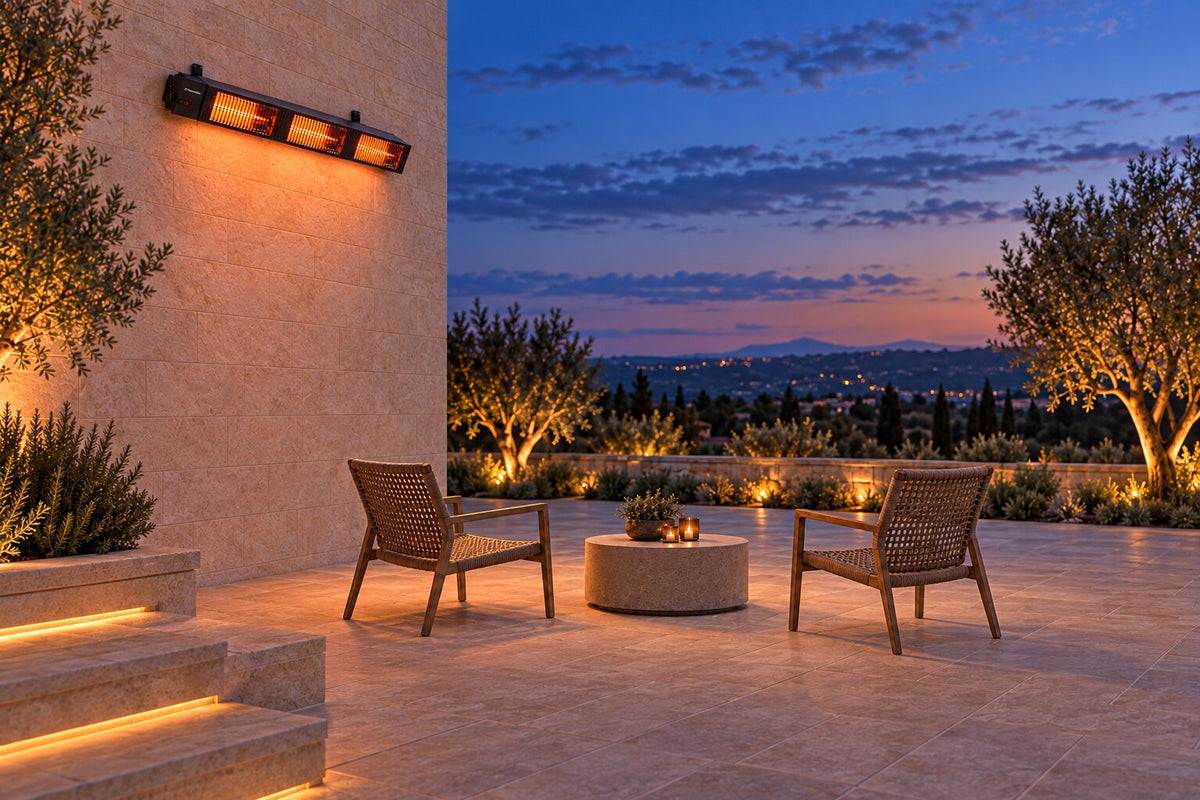
Infrared patio heaters are worth considering when you want to warm a specific seating area, have a suitable power supply, and can place the heater where its radiant output reaches the people using that space. They are less convincing when you expect one appliance to make an entire exposed backyard feel like a heated room.
The decision comes down to the evenings you actually spend outside. A heater aimed at two frequently used chairs can be more useful than a higher-powered unit pointing across an empty deck. Before buying, compare the seating layout, wind exposure, installation requirements, visible glow, and cost of your usual session.
This guide focuses on electric infrared patio heaters. It compares published features and practical planning considerations; it does not present a hands-on performance ranking or a guaranteed heating radius.
When is an infrared patio heater worth it?
- A good fit: You usually sit in one outdoor area, want warmth during occupied sessions, and have a safe mounting location or stable floor space near a suitable electrical supply.
- A conditional fit: Your patio is exposed, your table is large, or you need several heating zones. Layout and electrical planning will matter as much as the heater itself.
- A poor fit: You want uniform warmth throughout an open yard, cannot meet the model’s clearances, or would need an extension cord to reach the only outlet.
Start by drawing the chairs, table, walkway, and possible heater positions. Then check the exact model’s manual. This simple order helps you avoid buying a heater that has attractive features but nowhere appropriate to operate.
How infrared warmth feels outdoors
Electric infrared heaters use an electrically heated element to emit radiant energy. People, clothing, and surfaces in the radiant path absorb some of that energy. You may feel warmer while the air around your patio remains cool.
That explains both the appeal and the limitation. Sitting in front of a correctly positioned heater can feel noticeably different from sitting outside its main heating area. Turning your chair or moving behind an obstruction can change the sensation. A large table, partition, or another person may interrupt the path to parts of your body.
Think about where you want warmth while seated, rather than whether the entire deck measures a particular number of square feet. A heater can also warm nearby materials, which exchange heat with their surroundings. Saying infrared heaters “never heat the air” oversimplifies the process; direct radiant delivery is the feature that makes them useful for outdoor spot heating.
For a broader explanation of power, voltage, and mounting choices, see the infrared patio heater buying guide.
The main advantages
Useful warmth where people spend time
A fixed seating area gives you a defined target. Instead of trying to establish a uniform air temperature outdoors, you can aim the heater toward the chairs you use. This works particularly well as a planning approach for a reading corner, a small dining area, or a regular conversation spot.
The benefit depends on position and conditions. Quick element response does not guarantee that every guest immediately feels comfortable, especially at different distances or in changing weather.
Convenient electric operation
Electric models avoid propane-cylinder changes and an on-site fuel-burning flame. For some households, that makes frequent short sessions easier. A correctly installed plug-in model can be convenient, while a fixed hardwired system can suit a permanent seating arrangement.
Electrical access is still part of the purchase. Plug-in does not mean every nearby outlet or shared circuit is suitable. Higher-powered models may require a different voltage, a specific receptacle, or professional hardwiring.
Controls that suit changing evenings
Selectable heat levels let you adjust output as conditions or preferences change. A remote is useful for a mounted heater, and a timer can limit a session’s duration when used according to the manual. Neither feature establishes a fixed savings percentage.
Fanless models also avoid a blower moving air toward your table. That can suit dining and conversation, although fanless construction is not a guarantee that every control, relay, or moving feature makes no sound.
Options that preserve floor space
Wall-mounted heaters can leave walkways clear. Freestanding or tripod models offer other placement choices, provided the base, cord, and clearance requirements fit the patio. A portable design is only useful if the permitted location is also practical for guests and furniture.
The limitations to understand before buying
Coverage is a layout question
A published coverage figure is not a promise that every seat inside that area feels equally warm. Mounting height, aim, distance, obstructions, outdoor temperature, and exposure all change the result. Two patios with the same area can need very different arrangements.
For a long table, check the seats at both ends. For an L-shaped sofa, consider which seats face away from the heater. Adding wattage does not automatically solve an obstructed radiant path or an awkward mounting location.
Visible glow can affect the atmosphere
The heating element may emit visible light as well as infrared radiation. Its appearance depends on the element, screen, output setting, viewing angle, and surrounding light. If you prefer a dim dining space, ask about the exact model’s appearance at your intended setting.
“Low glare” is a feature description to investigate, not a synonym for invisible light. Avoid choosing only from a bright daytime product photo if evening appearance matters to you.
Warmth is closely tied to operation
Once the heater is switched off, direct radiant input ends as the element cools. Nearby surfaces may retain some warmth, but an open patio does not hold heat like an insulated room. Plan around occupied time instead of expecting a long period of residual comfort after shutdown.
Installation may change the value equation
The purchase price is only one expense. Suitable mounting, an appropriate circuit, a new outlet, or professional installation can affect the total. If the electrical work is substantial and you only sit outside occasionally, consider that cost before selecting a more powerful model.
Do infrared patio heaters work in wind?
Radiant energy does not depend on a stream of heated air traveling from the heater to your seat. That is useful outdoors. However, wind still increases heat loss from exposed people and surfaces, so the same heater can feel less effective on a breezy evening.
Treat “unaffected by wind” as too broad a description of real comfort. A site with recurring drafts deserves a closer look at where people sit and whether the permitted heater position can serve them. Weather resistance also says nothing about whether a freestanding unit is stable in a particular gust.
Do not solve poor comfort by moving closer than the required clearance or placing a heater beside a curtain. Any changes to wind shelter must preserve the model’s approved operating environment and required distances. In unsuitable weather, moving the gathering indoors may be the better decision.
There is no universal wind-speed or outdoor-temperature cutoff in this guide. Those limits need model instructions and relevant testing. When evaluating your own installed setup, record the weather and check each occupied seat without changing the approved installation.
How much does an electric infrared patio heater cost to run?
Calculate the energy cost from the power actually used, the operating time, and your applicable electricity rate:
Session cost = (watts ÷ 1,000) × hours × price per kWh
The examples below assume a constant full-rated input, a three-hour session, and an illustrative electricity rate of $0.20 per kWh. This is a chosen example, not a national average or a quote for your utility.
| Rated input | Energy in 3 hours | Cost per hour | Cost per 3-hour session |
|---|---|---|---|
| 1,500W | 4.5 kWh | $0.30 | $0.90 |
| 3,000W | 9.0 kWh | $0.60 | $1.80 |
| 4,500W | 13.5 kWh | $0.90 | $2.70 |
Multiply by the number of heaters and sessions. For example, one 1,500W heater used for ten of these three-hour sessions consumes 45 kWh and costs $9 at the assumed rate. Two identical heaters running for the same time consume twice the energy.
Use your utility’s applicable time-of-use rate if it varies through the evening. Add relevant variable charges when estimating a bill. These calculations exclude purchase, installation, and fixed utility charges. Lower settings or cycling can change consumption, but numbered heat levels should not be assumed to represent equal wattage steps unless the manufacturer specifies them.
Does infrared automatically mean lower bills?
No. Conventional electric resistance heating converts electrical input into heat at the appliance. Infrared describes how some of that heat reaches the surroundings; it does not make a 1,500W setting consume less electricity than another appliance continuously drawing 1,500W. The Australian government’s heating and cooling guide explains this conversion principle.
Potential savings come from using an appropriate amount of heat for fewer occupied areas or fewer hours. That needs a realistic comparison with what you would otherwise use. For whole-home heating, a heat pump is a different technology that moves heat, as the same government guide explains. An outdoor infrared heater should not be treated as a universal replacement for a home heating system.
Which ThermoMate setup fits your patio?
The following groups help connect the decision to specific models. They are based on published specifications, not comparative field tests. Confirm the current manual, nameplate, included hardware, and availability before ordering.
| Your priority | Models to compare | Published power and setup | What to check first |
|---|---|---|---|
| A freestanding seating-zone heater | EIHF1500B; EIHF1500V | 1500W maximum, 120V; EIHF1500B lists 750W/1500W settings; EIHF1500V lists oscillation | Base location, cord reach, clearances, and whether the radiant path reaches each chair |
| A choice of floor or wall placement | EIHFW1500B; EIHSW1500B | 1500W, 120V; freestanding/wall or tripod/wall configurations respectively | Approved orientation and the space needed for the base or tripod |
| A fixed wall location | EIH1500GLB | 1500W, 120V plug-in; nine heat settings | Mounting surface, outlet position, and seating alignment |
| A lower-glare feature to investigate | EIH1500B | 1500W, 120V wall-mounted; Schott glass screen | Current availability and visible glow at the setting you expect to use |
| A higher-power wall-mounted option | EIHS3000B | 3000W maximum, 240V plug-in with a NEMA 6-15P plug | Correct receptacle, circuit suitability, and model instructions |
| A permanent hardwired installation | EIH3000B; EIH4500B | 3000W at 220–240V or 4500W at 240V; wall/ceiling options | Professional electrical planning, mounting approval, and total installed cost |
If an overhead arrangement better suits your space, also compare the EIHC1500B hanging heater and EIHH1500B wall/ceiling heater. Both are listed as 1500W, 120V models, but their shapes and mounting arrangements differ. Check the exact installation instructions before treating either as suitable for your structure.
Do not select among these models by headline coverage alone. In particular, the EIHF1500V page contains different coverage figures in its description and specifications. Ask for clarification if your decision depends on that number. More power also does not remove the need for a clear radiant path.
Safety and weather checks that affect the decision
A heater is only a useful purchase if it can be operated as intended. Read the manual for the exact model, including permitted environments, mounting surfaces, height, clearances, electrical supply, and cleaning instructions. Outdoor suitability does not automatically establish indoor approval.
- Power: Use a suitable supply and connection for the model. Do not use an adapter to turn a 240V heater into a 120V appliance. Have a qualified electrician assess new circuits, hardwiring, or uncertain outlet suitability.
- Cords: For plug-in electric space heaters, CPSC recommends direct connection to a wall outlet, without extension cords or power strips. Keep cords away from hot surfaces, damage, and walking routes.
- Clearance: Keep furniture, fabrics, plants, and other combustible materials outside the required distances. A generic spacing rule is not a substitute for the model’s directional clearance diagram.
- Supervision: Keep children and pets away from hot surfaces. Protective controls and timers do not replace supervision. Switch off when the area is no longer in use.
- Weather: Follow the permitted exposure and storage instructions. An IP rating alone does not make every installation, plug connection, or weather condition acceptable.
See CPSC’s heater safety guidance for general portable-heater precautions. For mounting and electrical planning, use our electric patio heater installation guide alongside the current model manual.
A practical way to decide before you buy
- Define the session. Write down who sits outside, where they sit, and how long they normally stay. Use this to estimate operating cost.
- Check exposure. Note the prevailing breeze, open sides, and whether furniture blocks the proposed radiant path.
- Confirm installation. Match the manual to the available wall, ceiling, or floor location and electrical supply. Include installation work in the budget.
- Choose useful features. Prioritize mounting format, controls, and acceptable glow over a long feature list.
- Evaluate every seat. After correct installation, assess comfort from the normal seating positions under representative conditions. Record the setting, weather, and duration so your impressions are comparable.
For a frequently used, well-planned seating area, electric infrared heat can make outdoor time more comfortable and convenient. For a sprawling or very exposed space, you may need multiple carefully planned zones—or a different expectation of when that patio is comfortable to use.
Compare ThermoMate infrared patio heaters by power supply, mounting style, and controls. If you are still comparing fuel types, read the electric, propane, and natural gas patio heater comparison.
Frequently asked questions
Can a 1500W infrared heater warm an entire patio?
It may serve a seating zone, but wattage alone cannot establish whole-patio comfort. Consider the heater’s radiant pattern, mounting limits, distance, weather, and seat positions. Do not treat an advertised square-foot figure as a guaranteed result.
Are infrared heaters healthier than other heaters?
Choose a patio heater for comfort and suitability, not as a health treatment. This guide makes no claim that infrared patio heating improves circulation, treats symptoms, or provides therapeutic benefits.
Can I use an outdoor model inside?
Only if the exact model’s current instructions permit the intended indoor location and all installation conditions are met. Product-category names and weather ratings do not establish that approval. See the model-first indoor-use guide.
Will a timer automatically reduce my bill?
A timer can reduce consumption if it actually shortens operating time compared with your previous use. It does not reduce the electricity needed while the heater runs at the same input. Calculate savings from the change in power or hours rather than assuming a fixed percentage.