Electric vs Propane vs Natural Gas Patio Heaters: Cost, Heat & Safety
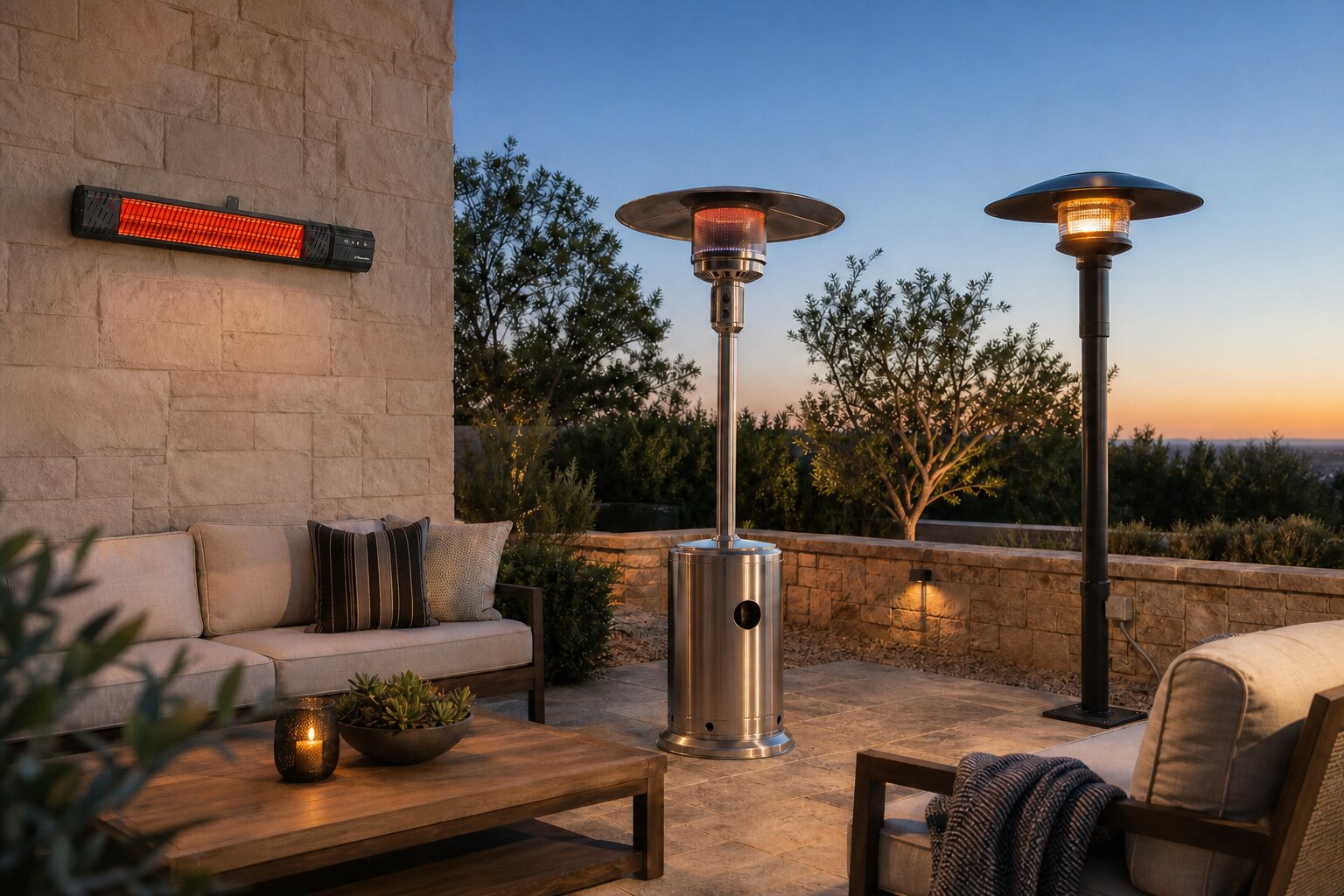
Short answer: choose an electric patio heater when you want targeted radiant heat, simple controls and no on-site combustion; choose propane when portability matters and cylinder handling is practical; choose natural gas when the heater will stay in one professionally planned outdoor location with an existing or feasible gas supply. None is automatically the cheapest, warmest or safest choice for every patio.
Safety first: outdoor fuel-burning heaters can create carbon monoxide, fire and burn hazards and must never be treated as indoor appliances. Follow the heater's listing, current manual and local requirements. Fixed gas work and new electrical circuits belong with qualified professionals.
The useful comparison is not simply electric versus gas. Propane and natural gas solve different installation problems, and two heaters with very different input ratings can create very different comfort zones. Start with the occupied area, available energy source, mounting or portability needs, ventilation and clearances. Then compare operating cost with your own utility or fuel price.
This updated guide replaces broad claims with a decision table and three transparent cost formulas. If you are specifically shopping electric infrared models, use the infrared patio heater buying guide after choosing your fuel path.
Electric vs propane vs natural gas: the decision at a glance
| Factor | Electric infrared | Propane | Natural gas |
|---|---|---|---|
| Best starting use | A defined seating or work zone with suitable 120V or 240V power | Open outdoor areas where the heater needs to move and cylinders can be handled safely | A fixed open-air location where a compliant gas connection is practical |
| Heat delivery | Radiant energy aimed toward people and solid surfaces | Model dependent; many tall patio units combine radiant heat with hot rising combustion gases | Model dependent; fixed units may be radiant or use another listed design |
| Site work | A compatible receptacle may be simple; 240V and hardwired models need electrical planning | Usually no fixed utility line, but cylinder connection, inspection, storage and replacement remain part of ownership | Professional fixed gas-line and appliance installation; permit and local-code requirements may apply |
| Portability | Freestanding and tripod models can move within safe cord reach; wall models are fixed | Often portable within the limits of the listed design and safe cylinder handling | Fixed |
| At point of use | No fuel combustion or combustion exhaust | Combustion products, open-flame or hot-burner hazards and cylinder risks | Combustion products and fixed fuel-line/burner risks |
| Cost input to collect | Your electricity rate in dollars per kWh | Your delivered/refill price per gallon, or exchange price plus usable runtime | Your utility price per therm or per thousand cubic feet, including applicable delivery charges |
Fast routing: a compact seating zone with a suitable outlet often points toward electric infrared. A changing event layout with no convenient power may point toward propane. A permanent hospitality or residential layout with an available gas service may justify natural gas. Each answer is conditional on the exact heater being approved for the location.
1. Compare the comfort zone, not only watts or BTUs
Electric heaters are normally labeled in watts. Fuel-burning heaters are normally labeled in BTU per hour. Both describe energy input or rate, but neither tells you by itself how warm a chair will feel.
Radiant heat travels through space and is absorbed by people and cooler solid objects in its path. That makes line of sight, distance and aiming important. ThermoMate's electric patio-heater range uses infrared radiant elements, so the useful question is whether the heater can direct an appropriate zone toward the occupied area while meeting the manual's mounting and clearance rules.
A tall propane “mushroom” heater often sends heat outward from an elevated burner and reflector while hot combustion gases rise. A fixed natural-gas heater may use a similar form or a different listed radiant design. Do not assume every gas heater spreads heat the same way, and do not translate a large BTU number directly into square feet of comfort.
For any fuel, sketch the patio before buying:
- Mark the seats, dining positions or work zone that should feel warm.
- Mark walls, roof edges, umbrellas, curtains, plants and other combustibles.
- Note open edges and prevailing wind, but do not describe any heater as “windproof.”
- Record available receptacles, electrical service, gas service and permitted cylinder-storage locations.
- Check whether a portable base or tripod would obstruct a walkway.
- Use the exact model manual to test the proposed location before purchase.
If the space is covered, screened or partially enclosed, stop treating it as a generic patio. Review the model's intended-use statement and the model-first indoor and enclosed-space guide. The absence of rain does not make a location safe for a fuel-burning outdoor heater.
2. Calculate operating cost with your own rate
There is no credible national rule that electricity, propane or natural gas is always cheapest. Rates vary by state, utility, supplier, season, delivery method and service charge. Heater input also differs. Use the formulas below as an energy-cost comparison, then keep installation, maintenance and fuel logistics separate.
Electric heater cost per hour
Formula: heater watts ÷ 1,000 × electricity price per kWh = cost per hour at that setting.
The U.S. Energy Information Administration's August 2026 outlook lists a 2026 U.S. residential electricity average of 18.27 cents per kWh. Using that national figure only as an illustration:
| Electric input setting | Calculation at $0.1827/kWh | Illustrative energy cost/hour |
|---|---|---|
| 1,500W | 1.5 × $0.1827 | $0.27 |
| 3,000W | 3.0 × $0.1827 | $0.55 |
| 4,500W | 4.5 × $0.1827 | $0.82 |
Replace $0.1827 with the rate on your bill. If the heater has lower heat settings, use the wattage of the selected setting when the manufacturer publishes it. Timer use changes runtime, not the full-power hourly rate.
Propane heater cost per hour
The EIA energy conversion reference lists propane at approximately 91,452 BTU per gallon. The transparent formula is:
Formula: heater input in BTU/h ÷ 91,452 × delivered propane price per gallon = cost per hour at full input.
For example, a heater rated at 40,000 BTU/h would use about 0.44 gallon per hour at its full listed input: 40,000 ÷ 91,452 = 0.44. Multiply 0.44 by your actual per-gallon refill price. If you use a tank exchange, use the exchange price and supplier/manufacturer information about usable fuel and runtime rather than assuming the cylinder's nominal size equals delivered fuel.
Keep travel, delivery, exchange convenience and partially used cylinders outside the basic fuel formula. Those practical costs can still decide which option works for you.
Natural-gas heater cost per hour
EIA's current conversion reference uses approximately 1,036 BTU per cubic foot of natural gas. If your bill is priced per thousand cubic feet:
Formula: heater input in BTU/h ÷ 1,036,000 × gas price per thousand cubic feet = fuel cost per hour at full input.
Using a 40,000 BTU/h input and EIA's August 2026 national residential forecast of $15.86 per thousand cubic feet as an illustration gives about $0.61 per hour: 40,000 ÷ 1,036,000 × $15.86. Your utility's delivery charges, minimum bill, taxes and local rate can change the result.
If your bill uses therms, divide the heater's BTU/h by 100,000, then multiply by your price per therm. Do not compare the $0.27 electric example with the $0.61 gas example as if the two appliances deliver identical comfort; their input rates and heat patterns are not equivalent.
3. Compare installation and ownership, not fuel alone
Electric infrared
A 120V plug-in heater can be the shortest route when an appropriate receptacle is already within the permitted cord reach. It is not permission to use a convenience extension cord or power strip. A 1500W heater can draw about 12.5 amps at 120V, so the receptacle, circuit condition and other loads matter.
Higher-output electric models can require 240V. Within ThermoMate's range, connection type is model-specific: some 240V heaters use a dedicated plug configuration while others are hardwired. A new circuit, receptacle or fixed connection should be planned by a qualified licensed electrician. Read the electric patio heater installation guide and download the exact manual before choosing the mounting point.
Propane
Propane can avoid a permanent utility connection and can suit changing outdoor layouts. Ownership still includes cylinder connection checks, safe transport, upright use, leak-response knowledge and permitted storage. A portable heater also needs a stable location where its base will not block exits or invite impact.
NFPA's outdoor-heater guidance says propane heaters should be used according to their listing and manufacturer instructions, including ventilation, clearances, lighting, shutdown, inspection and storage. Local fire rules can restrict cylinders, exits and use in assembly occupancies. Check the authority having jurisdiction instead of assuming a residential setup transfers to a restaurant or event.
Natural gas
A fixed natural-gas heater removes cylinder swapping but gives up portability. The appliance, shutoff, piping, supports, combustion clearances and final location need professional planning under the applicable instructions and local rules. Existing gas service does not prove that capacity or routing is suitable for another appliance.
Natural gas can make sense when the outdoor layout is stable and recurring use justifies fixed infrastructure. It is a poor fit when furniture, umbrellas or traffic patterns change often enough to conflict with the permanent heat zone.
4. Safety differences that matter
“Electric” does not mean hazard-free, and “outdoor” does not mean every location is acceptable. Use the fuel-specific checklist below before comparing convenience.
Electric safety checklist
- Match model, voltage, connection type, mounting method and intended environment.
- Use an appropriate direct wall receptacle when the manual requires it; do not substitute a power strip or convenience extension cord.
- Keep the plug, cord and connection protected as directed and stop if a plug, outlet or faceplate becomes unusually hot.
- Respect all model-specific clearances and keep the radiant path away from combustibles.
- Use a licensed electrician for new circuits, 240V uncertainty and hardwired work.
- Do not assume an electric model is approved indoors. The exact manual and rating label control.
Propane safety checklist
- Use an outdoor heater only where its listing and manual permit; never move it into a home, garage, tent or other enclosed location for extra warmth.
- Keep combustibles and people outside required clearances. NFPA's general outdoor-heater fact sheet uses at least 3 feet as a starting point, but the appliance instructions or local rule may require more.
- Inspect the cylinder, valve, regulator and hose as instructed before use. Keep hoses visible, protected and as short as the listed setup requires.
- Keep the heater stable and protect it from impact. Turn it off when the area is unoccupied.
- Follow local rules for cylinder storage; do not treat a garage, roof or exit path as a default storage location.
- Stop and move to fresh air if anyone experiences possible carbon-monoxide symptoms such as headache, dizziness, weakness, nausea, sleepiness or confusion, then seek emergency help.
Natural-gas safety checklist
- Use a listed heater in the environment and orientation specified by the manufacturer.
- Have qualified professionals handle fixed fuel piping, shutoffs, connection and required inspection.
- Keep combustion air, clearances, exits and building openings in the design review.
- Do not enclose an outdoor heater later with curtains, screens, glazing or temporary walls without a new approval review.
- Know the gas shutoff location and follow the manufacturer's leak or abnormal-operation instructions.
- Do not use the heater if the flame, ignition or odor is abnormal; shut down safely and arrange service.
The U.S. Consumer Product Safety Commission warns that outdoor heaters used indoors can create deadly carbon-monoxide buildup. Carbon monoxide is colorless and odorless. An alarm may provide added protection in appropriate building locations, but it never makes an outdoor fuel-burning heater acceptable indoors and never replaces correct appliance use.
5. Emissions and environmental claims: use precise language
An electric patio heater has no on-site combustion emissions at the point of use. That is different from saying it has no emissions at all. Its broader footprint depends on the electricity supply, while renewable electricity can reduce the generation-related impact.
Propane and natural gas release carbon dioxide when burned. The U.S. Environmental Protection Agency publishes separate fuel-emission factors, and both fuels also create combustion-safety considerations at the appliance. Avoid a blanket claim that natural gas is “clean” or that one fuel is always the greenest choice.
A practical environmental decision starts with right-sizing the occupied zone, using only the needed heat setting and runtime, and avoiding a heater that warms an empty area. Controls and timers can help reduce operating time, but do not promise a fixed savings percentage without a defined baseline and measured use.
6. Which patio heater fits your situation?
Choose electric infrared when:
- you want a defined radiant zone instead of a tall floor heater;
- no on-site fuel combustion is a priority;
- a suitable 120V or professionally planned 240V supply is available;
- wall, ceiling, tripod or freestanding placement can meet the exact manual; and
- quiet controls, multiple heat levels or a timer are useful to the way you occupy the patio.
ThermoMate currently offers 120V wall-mounted and freestanding options as well as higher-output 240V models. Browse the electric infrared heater collection, then verify the live product page and current manual before purchase. For a compact 120V wall zone, compare the 1500W EIH1500GLB. For freestanding use, compare the 1500W EIHF1500B. If you are planning a permanent higher-output zone, review the electrical path before looking at a 240V 3000W model.
Choose propane when:
- the heater must move between genuinely open outdoor zones;
- safe cylinder transport, connection and permitted storage are realistic;
- the base and required clearances fit without blocking travel or exits; and
- you accept refill or exchange logistics as part of each season.
Choose natural gas when:
- the outdoor layout and heat zone are permanent;
- a qualified professional confirms a feasible gas supply and compliant location;
- fixed piping and permit/inspection requirements are acceptable; and
- avoiding cylinder replacement matters more than portability.
7. A final five-question decision
- Where will people actually sit? Choose the heat pattern and placement for that occupied zone.
- What energy source is truly available? Confirm voltage/circuit or fuel infrastructure before selecting a heater.
- Can the exact heater meet every use, ventilation and clearance rule? If not, change the model or location.
- What does one hour cost at your rate? Use the formulas above instead of a national “cheapest fuel” claim.
- Will the layout move? Portability favors an approved portable design; recurring fixed use may justify permanent infrastructure.
For many residential seating zones, electric infrared is the most direct option when suitable power and model-approved placement already exist. Propane earns its place when open-air portability outweighs cylinder handling. Natural gas is a site-planning decision for a fixed location, not simply a fuel swap.
Once you choose electric, compare wattage, voltage, mounting and weather rating in ThermoMate's complete infrared patio heater buying guide. Always download the current model instructions from the ThermoMate manual library before installation.
Frequently asked questions
Is an electric patio heater cheaper to run than propane?
It can be, but not by definition. Multiply electric kW by your $/kWh rate. For propane, divide heater BTU/h by 91,452 and multiply by your delivered $/gallon. Compare actual models and local rates, then account separately for installation and refill logistics.
Is natural gas always cheaper than electricity?
No universal answer applies. Natural-gas commodity cost may be low in some areas, but the heater input, delivery charges, minimum bill and fixed installation cost matter. Electricity prices also vary widely by state. Use your bills and the formulas in this guide.
Do gas patio heaters produce more heat than electric heaters?
Many gas patio heaters have a larger input rating than a single 1500W electric heater, but the comfort comparison is not one number. Reflector design, radiant line of sight, mounting height, wind exposure, distance and occupied-zone size all affect what people feel.
Can I use a propane or natural-gas patio heater in a garage?
Do not use an outdoor fuel-burning heater inside a garage or other enclosed space. CPSC warns that outdoor heaters used indoors can cause deadly carbon-monoxide buildup. Use only equipment specifically listed and instructed for the environment.
Does an electric patio heater produce carbon monoxide?
An electric resistance/infrared heater does not burn fuel at the appliance, so it does not create combustion carbon monoxide at the point of use. It can still create electrical, burn and fire hazards, and the model may still be restricted to outdoor use.
What size patio heater do I need?
Start with the occupied seating zone, exposure, distance and mounting position rather than total patio square footage. Then use the heater's current manual and product documentation. Do not infer coverage from watts or BTU/h alone.
Sources and review notes
- U.S. Energy Information Administration, August 2026 Short-Term Energy Outlook summary — illustrative 2026 U.S. residential electricity and natural-gas prices.
- U.S. Energy Information Administration, energy units and calculators — propane and natural-gas heat-content conversions.
- U.S. Consumer Product Safety Commission, Indoor Heating Safety — outdoor heaters must not be used indoors.
- U.S. Consumer Product Safety Commission, Carbon Monoxide Q&A — CO sources, symptoms and prevention.
- National Fire Protection Association, Outdoor Heater Safety fact sheet — general propane/electric outdoor-heater precautions and local-code considerations.
- U.S. Environmental Protection Agency, greenhouse-gas calculator references — fuel-specific emissions context.