Best Electric Patio Heaters for Every Outdoor Space - 2026 Buyer’s Guide
Short answer: the best electric patio heater is the model that matches the occupied seating zone, available voltage and approved mounting method—not automatically the one with the highest wattage. For a compact area with a standard receptacle, start with a 1500W 120V model. For a larger permanent zone, consider a 240V model only after confirming the connection, circuit and installation path.
Before you buy: verify the current product page, rating label and exact model manual. A weather rating does not cancel clearance rules, and a higher-voltage model is not compatible with a standard 120V outlet. New 240V circuits and hardwired connections should be evaluated and installed by a qualified licensed electrician under the manual and local requirements.
This 2026 buyer’s guide matches ThermoMate’s current electric infrared patio heaters to real-world use cases: compact patios, balconies, flexible seating areas, covered outdoor zones and larger fixed installations. It is based on published product specifications, current availability and installation requirements checked on September 3, 2026. It is not a hands-on laboratory ranking, and it does not invent temperature-rise, sound, glare or coverage test results.
If you want to learn the selection logic before comparing individual models, start with the infrared patio heater buying guide. If you are ready to shop, browse the live ThermoMate electric infrared heater collection and recheck price and availability before ordering.
Best electric patio heaters: quick picks for 2026
| Best for | Model | Power connection | Mounting | Why it stands out |
|---|---|---|---|---|
| Compact fixed wall zone | EIH1500GLB | 1500W, 120V plug-in | Wall | Compact carbon-fiber design, 9 heat levels, 24-hour timer and IP65 listing |
| Floor-to-wall flexibility | EIHFW1500B | 1500W, 120V plug-in | Freestanding or wall | One model supports two approved setup paths, with 8 heat levels and an 8-hour timer |
| Adjustable tripod placement | EIHSW1500B | 1500W, 120V plug-in | Tripod or wall | Adjustable stand, wall hardware, 3 heat levels, 24-hour timer and IP65 listing |
| Portable tower with lower-output option | EIHF1500B | 750W / 1500W, 120V plug-in | Freestanding | Carbon-fiber element, 2 output levels, 24-hour timer, tip-over protection and IP55 listing |
| Oscillating freestanding heat | EIHF1500V | 1500W, 120V plug-in | Freestanding | 60-degree oscillation, 8 heat levels, 8-hour timer, tip-over protection and IP65 listing |
| Higher-output 240V plug-in zone | EIHS3000B | 1000W / 2000W / 3000W, 240V NEMA 6-15P | Wall | Three output levels, carbon-fiber element, 240V plug connection and IP65 listing |
| Permanent 3000W hardwired zone | EIH3000B | 1500W / 3000W, 220–240V hardwired | Wall or ceiling | Carbon-fiber element, two output levels, 24-hour timer and IP54 listing |
| Largest fixed ThermoMate output | EIH4500B | 2250W / 3600W / 4500W, 240V hardwired | Wall or ceiling | Three output levels, carbon-fiber element, 24-hour timer and IP54 listing |
| Low-glare wall option when available | EIH1500B | 1500W, 120V plug-in | Wall | Golden-halogen element behind a Schott glass screen, 9 levels, 24-hour timer and IP65 listing |
Availability note: eight models above showed an Add to Cart option on the U.S. collection during the September 3, 2026 check. EIH1500B showed Sold out. Inventory and product specifications can change, so the live collection and product page control at publication and purchase.
How we matched the “best” heater to each use case
A useful best-of guide should explain its method. We compared the nine models shown in ThermoMate’s U.S. infrared-heater collection by voltage, connection type, permitted mounting, published output settings, element, controls, IP rating and current purchase status. We then matched those facts to different installation constraints.
We did not assign unsupported comfort scores. The matrix brief calls for future hands-on heat-up, glare, sound and temperature observations, but no verified test dataset was supplied for this article. Accordingly, terms such as “best for” mean the strongest published specification fit for the named use case. They do not mean one unit produced a measured temperature rise or outperformed another in a controlled trial.
Coverage claims are also treated cautiously. Patio comfort changes with distance, aiming, open edges, wind, roof height, clothing and how many people share the radiant path. One current product page, EIHF1500V, describes up to 100 square feet in the body but 200–300 square feet in its specification block. Until that conflict is resolved, this guide does not use either number to rank that model.
Start with the outdoor space, not the product photo
Small patio or balcony
Begin with the seats you want to warm, not the full floor plan. A 1500W 120V heater is the practical starting class when a suitable direct receptacle is available and the exact model can meet the site’s clearance and weather rules. A fixed wall unit such as EIH1500GLB preserves floor area; a freestanding unit can be repositioned within its approved cord reach.
Balconies deserve an extra rules check. Building management, lease terms, local fire requirements and overhead or side clearances may limit heater use even when the appliance is marketed for outdoor settings. Never improvise a mount on a railing, extend the cord to reach another unit or aim radiant heat at curtains, furniture, plants or stored items.
Covered patio, porch or gazebo
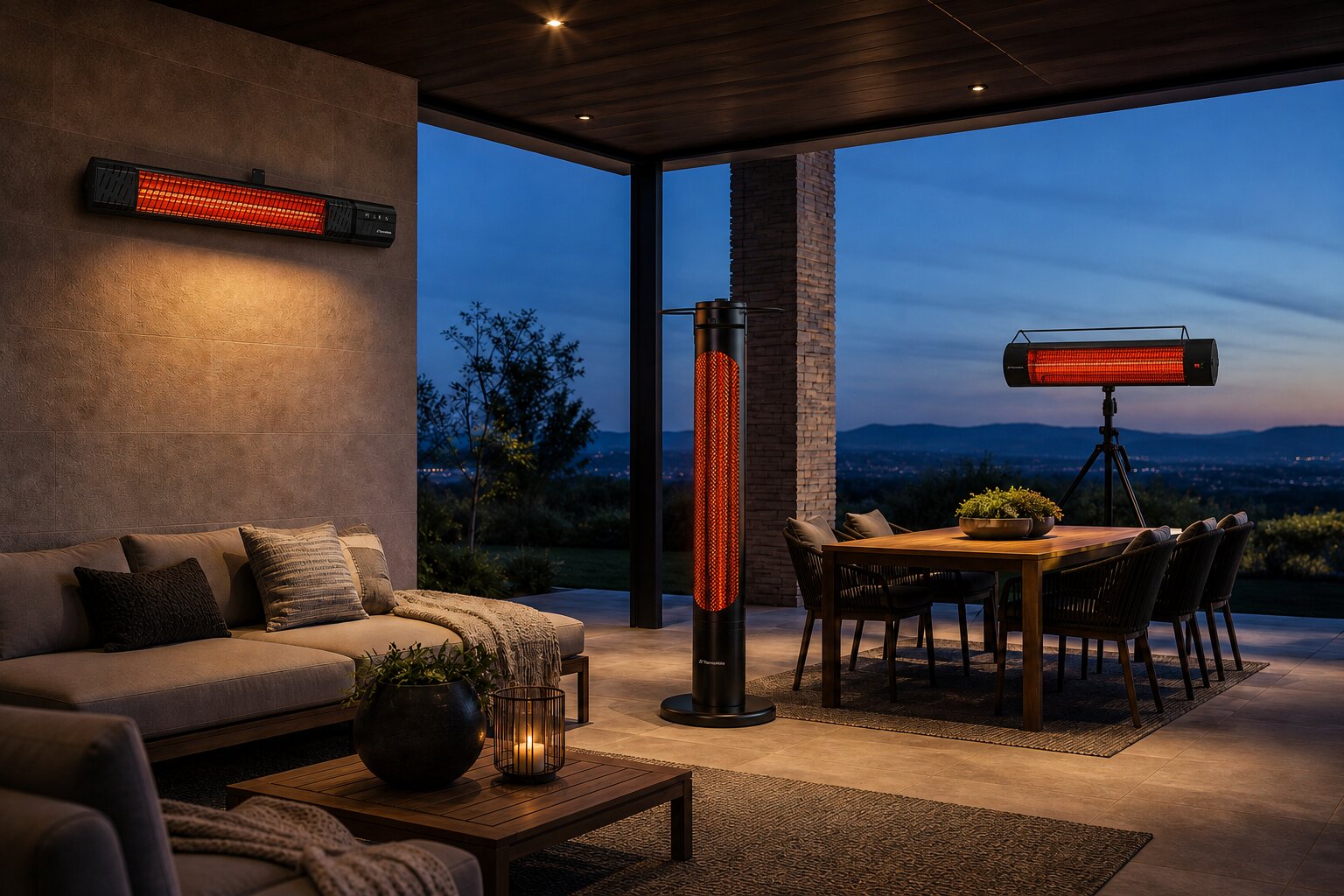
A roof can reduce direct rain and help define a seating zone, but it also creates overhead surfaces that must remain outside the manual’s required clearances. Wall-mounted, ceiling-permitted or tripod models may fit, depending on the exact instructions. Do not assume every long bar heater is approved for ceiling mounting: EIH3000B and EIH4500B list wall-or-ceiling installation, while several other models list wall mounting only.
If screens, curtains, glazing or temporary panels make the location partly enclosed, check the intended-use language rather than relying on the word “patio.” Use the model-first indoor and enclosed-space guide before selecting a location. An IP rating describes ingress protection under defined conditions; it does not declare an enclosure safe, remove ventilation considerations for other appliances or override the manual.
Flexible seating or seasonal layout
Choose a freestanding or tripod model only when its base can remain stable and outside the walking path. EIHF1500B provides 750W and 1500W settings in a tower format. EIHF1500V adds oscillation. EIHFW1500B can operate freestanding or move to an approved wall installation, while EIHSW1500B includes an adjustable tripod and wall-mount path.
Portability is limited by safe power access. The heater should not become a reason to route a cord across a doorway, under a rug or through standing water. CPSC guidance for portable electric heaters says to plug them directly into a wall outlet rather than an extension cord or power strip, place them on a stable level surface and keep combustible items at least three feet away. The exact model manual may require different or greater clearances, so follow the more restrictive instruction.
Large patio, workshop or commercial seating zone
A larger floor area does not automatically require one 4500W heater. Long tables or separated seating groups may be better served by multiple correctly aimed zones, subject to circuit capacity and the manuals. Start by marking each occupied zone and the permitted mounting points. Then determine whether an approved 240V plug-in or hardwired path is realistic.
EIHS3000B is the 240V plug-in option in the current range and lists a NEMA 6-15P connection. EIH3000B and EIH4500B are hardwired models. A 240V plug is not compatible with a standard 120V receptacle, and a hardwired heater is not a DIY plug conversion. For a restaurant or multi-unit layout, include total electrical load, simultaneous use, customer traffic, emergency access and local approval in the design review.
Choose 120V or 240V before choosing features
Voltage is a hard constraint. At full output, current is approximately watts divided by volts: 1500W at 120V is about 12.5 amps, 3000W at 240V is about 12.5 amps and 4500W at 240V is about 18.75 amps. These calculations explain why wattage and voltage belong together; they do not specify a breaker, conductor or receptacle for your project.
| Power path | Models in this guide | What to confirm |
|---|---|---|
| 120V plug-in | EIHF1500V, EIHF1500B, EIHFW1500B, EIHSW1500B, EIH1500B, EIH1500GLB | Correct direct receptacle, circuit condition and capacity, dry/protected connection, cord reach and other loads |
| 240V plug-in | EIHS3000B | Correct NEMA 6-15P-compatible receptacle and circuit; no adapter or plug modification |
| 220–240V hardwired | EIH3000B | Qualified licensed electrician, dedicated-circuit requirements, disconnecting means, manual and local code |
| 240V hardwired | EIH4500B | Qualified licensed electrician, service capacity, circuit design, mounting location, manual and local code |
For installation planning, use ThermoMate’s electric patio heater installation guide and manual library. If the blog, product page and manual ever disagree, stop and ask ThermoMate support which current document controls for that exact model.
Pick the mounting style that fits the way the space changes
Wall-mounted
Wall mounting saves floor space and keeps the heater in a repeatable position. It works best when the seating zone is stable and the wall can accept the specified hardware. Confirm mounting height, allowed aiming range, structural support, overhead and side clearances, cord routing and access to controls. Do not mount a unit closer to the ceiling simply to hide it.
Ceiling-mounted
Only use ceiling mounting when the exact model instructions allow it. Within this comparison, EIH3000B and EIH4500B publish wall-or-ceiling positioning. A ceiling-permitted heater still needs a compliant structure, aiming angle, clearance envelope and electrical connection. Decorative ceilings, fabric canopies, fans and retractable roofs can change whether the location works.
Freestanding or tripod
Freestanding and tripod heaters offer layout flexibility without a permanent wall location. They also introduce a base, cord and traffic interaction that a fixed unit avoids. Choose a level surface, keep the unit outside travel paths and do not use furniture or improvised blocks to raise it. Tip-over protection is a useful backup feature, not a substitute for stable placement and supervision.
Compare heat levels, timers, elements and weather ratings
Heat levels: more settings make it easier to reduce output when people sit closer or the weather is mild. They do not prove greater efficiency. Energy use depends on the actual wattage at the selected level and how long the heater runs.
Timers: a timer can reduce forgotten runtime, but it should not be described with a fixed savings percentage unless the comparison baseline and measured use are defined. Confirm whether the timer is 8 hours or 24 hours and whether the controls return to a safe default after a power interruption.
Carbon fiber and golden halogen: element type can influence visible glow, response and product design, but this guide has no controlled glare or heat-up measurements. If low glare matters for dining or conversation, treat EIH1500B’s Schott glass claim as a feature to verify when the model returns to stock. Do not generalize one product claim across the full range.
IP rating: the current range includes IP54, IP55 and IP65 listings. A higher number can indicate greater tested ingress protection, but it does not mean “safe in any weather.” The installation orientation, connection, cable, receptacle and exposure limits in the manual still control. Never spray-clean a heater or leave electrical connections in water unless the exact instructions explicitly permit it.
Model-by-model recommendations
EIH1500GLB: best starting point for a compact fixed wall zone
EIH1500GLB is the clearest first look for shoppers who want a compact 120V wall-mounted carbon-fiber model. The current page lists 1500W, 12.5A, nine heat settings, a 24-hour timer and IP65 protection. It avoids a floor stand, so it fits layouts where furniture and walkways remain stable. Compare its approved position and 3.2-foot cord reach with the planned receptacle before buying.
EIHFW1500B: best when you may switch from floor to wall
EIHFW1500B is useful when the mounting decision is not final because the product supports both freestanding and wall-mounted use. It lists a 1500W carbon-fiber element, eight heat levels, an eight-hour timer, remote control, tip-over and overheat protection, and IP65 protection. Use only the supplied, approved configurations—the dual-purpose design is not permission to create a custom stand or bracket.
EIHSW1500B: best for adjustable tripod placement
EIHSW1500B combines an adjustable tripod with wall-mount hardware. It lists three heat settings, a 24-hour timer, remote control, a carbon-fiber element and IP65 protection. It is a practical candidate when the seating arrangement changes seasonally, provided the tripod can stand on a level surface without entering the traffic path.
EIHF1500B: best portable tower for a lower-output setting
EIHF1500B is a freestanding carbon-fiber tower with 750W and 1500W output levels, a 24-hour timer, remote control, tip-over protection and an IP55 listing. The lower setting can be useful when full output is unnecessary, but actual energy use still depends on the selected level and runtime. Keep the base stable and the direct wall connection safely within the cord’s reach.
EIHF1500V: best when oscillation matters
EIHF1500V offers 60-degree oscillation, eight heat levels, an eight-hour timer, remote control, tip-over protection and an IP65 listing. It can sweep its radiant direction across a wider seating arrangement, but oscillation also means each position is not continuously in the direct path. Do not choose it by the page’s conflicting square-foot claims; use layout, distance, exposure and manual requirements instead.
EIHS3000B: best current 240V plug-in choice
EIHS3000B is the range’s 3000W 240V plug-in model. Its current product page lists a carbon-fiber element, 1000W/2000W/3000W settings, wall mounting, IP65 protection and a NEMA 6-15P plug. The handle and some older marketing assets still say “golden halogen,” so the current page and exact manual should be reconciled before publication. Confirm the receptacle and circuit with a qualified electrician; never use an adapter to fit a different outlet.
EIH3000B: best for a permanent 3000W hardwired layout
EIH3000B lists 1500W and 3000W output, a carbon-fiber element, wall-or-ceiling mounting, a 24-hour timer, IP54 protection and a 220–240V hardwired connection. It suits a planned permanent zone, not a casual plug-in upgrade. The product page currently shows Add to Cart, but installation feasibility should be confirmed before purchase.
EIH4500B: best for the highest-output fixed ThermoMate zone
EIH4500B is the largest-output option in the current collection, with published settings of 2250W, 3600W and 4500W. It lists a carbon-fiber element, wall-or-ceiling mounting, a 24-hour timer, IP54 protection and a 240V hardwired connection. Treat it as an electrical and layout project. Its higher input does not guarantee better comfort if the seating zone, aiming or mounting point is wrong.
EIH1500B: best low-glare feature set to watch for restock
EIH1500B is the only current ThermoMate product page in this group that specifically describes a Schott glass screen intended to reduce visible glare. It lists a 1500W golden-halogen element, nine heat levels, a 24-hour timer, wall mounting and IP65 protection. The U.S. page showed Sold out during this review, so do not lead a current shopping recommendation with it until availability is reconfirmed.
Five buying mistakes to avoid
- Ranking by wattage alone. Higher input cannot fix poor aiming, excessive distance, an exposed edge or a mounting point that misses the seats.
- Buying before checking voltage. A 240V plug-in or hardwired model is not a substitute for a 120V appliance and may require professional electrical work.
- Treating an IP rating as unlimited weather permission. The manual still controls orientation, clearances, connection protection, storage and cleaning.
- Using a convenience extension cord or power strip. Plan a suitable direct connection instead of stretching the heater to a location the cord cannot safely reach.
- Assuming every product claim is internally consistent. Recheck the current page and manual, especially where titles, element descriptions or coverage numbers conflict.
Final buying checklist
- I marked the occupied seating or work zone, not only the patio’s total area.
- I recorded roof, wall, screen, curtain, furniture, plant and walkway constraints.
- I know whether the location needs wall, ceiling, floor or tripod mounting.
- I confirmed the exact model permits that mounting method and intended environment.
- I verified 120V plug-in, 240V NEMA 6-15P or hardwired connection before ordering.
- I checked the receptacle, circuit and other loads, with a qualified electrician where needed.
- I can place the plug and cord without an extension cord, power strip, adapter or trip hazard.
- I checked the current manual for height, aiming, clearances and weather-exposure rules.
- I chose heat levels, timer, remote and oscillation for the way the zone will actually be used.
- I rechecked current price, availability, specifications and documentation on the live product page.
Ready to compare? Visit ThermoMate’s electric infrared patio heater collection. For a transparent fuel and hourly-cost comparison, also read electric vs propane vs natural gas patio heaters. For general portable-heater precautions, review the U.S. Consumer Product Safety Commission guidance.
Frequently asked questions
What is the best electric patio heater for a small patio?
A 1500W 120V model is the practical starting class for a compact seating zone when a suitable direct receptacle and approved placement are available. Choose wall-mounted EIH1500GLB when floor space is limited, or compare a freestanding or tripod model when the layout needs to change.
Is a 3000W patio heater better than a 1500W heater?
Not automatically. A 3000W heater provides a higher input class but also requires 240V in ThermoMate’s current range. A well-aimed 1500W heater can be the better fit for a compact zone, while 3000W may suit a larger permanent location with compatible power and mounting.
Can I plug a 240V patio heater into a normal outlet?
No. A 240V NEMA 6-15P plug does not fit or operate from a standard 120V receptacle. Do not use an adapter or modify the plug. Have a qualified licensed electrician confirm the required receptacle, circuit and installation.
Are IP65 patio heaters waterproof?
IP65 is a defined ingress-protection rating, not permission for any exposure, mounting or cleaning method. Follow the exact product manual for orientation, electrical-connection protection, weather limits, storage and maintenance.
Should I choose a wall-mounted or freestanding electric patio heater?
Choose wall mounting for a stable seating zone where saving floor space matters and the structure supports an approved installation. Choose freestanding or tripod placement when the zone changes, but keep the base stable, the cord directly connected and the unit outside walkways.
How much does an electric patio heater cost to run?
Multiply the selected input in kilowatts by your electricity price per kWh. At full output, a 1500W heater uses 1.5 kWh per hour, a 3000W heater uses 3.0 kWh and a 4500W heater uses 4.5 kWh. Use your local rate and actual runtime rather than a universal cost claim.
Can I use an extension cord with an electric patio heater?
Plan for an appropriate direct connection. CPSC guidance for portable electric heaters says not to use an extension cord or power strip because high loads can create overheating and fire risk. Follow the exact heater manual and have an electrician evaluate inadequate outlet placement.